
‘We refuse to be silenced’: Gaza doctors documentary team denounces BBC After BAFTA win

A film about Gaza’s dying medical system was commissioned, shelved, and then honored by Britain’s most prestigious television award. The acceptance speech that followed may be the most pointed moment in BAFTA history.
There is a particular kind of institutional embarrassment that arrives not with a scandal but with an award. On Sunday evening, the British Academy of Film and Television Arts handed its current affairs prize to a documentary that the BBC — Britain’s publicly funded national broadcaster, the institution that originally commissioned the film — had decided the British public should never see.
The filmmakers did not let the irony pass quietly.
The Film, the Commission, and the Decision That Backfired
Gaza: Doctors Under Attack is an investigative documentary examining what happened to Gaza’s medical system and the people who worked inside it during Israel’s military campaign in the territory. The film was produced by a team led by journalist Ramita Navai and executive producer Ben De Pear, commissioned by the BBC as part of its public affairs mandate, and then quietly shelved before broadcast.
The BBC’s stated reason was concern about impartiality. The broadcaster did not air the film. Channel 4 subsequently acquired and broadcast it. On Sunday, it won the BAFTA.
The sequence of events is worth holding in full: a British public broadcaster paid to produce an investigation into one of the most consequential humanitarian situations of the decade, then declined to show it to the British public on impartiality grounds, and then watched the film win the country’s highest television honor in the category the BBC ostensibly exists to serve — current affairs journalism.
What Happened on Stage
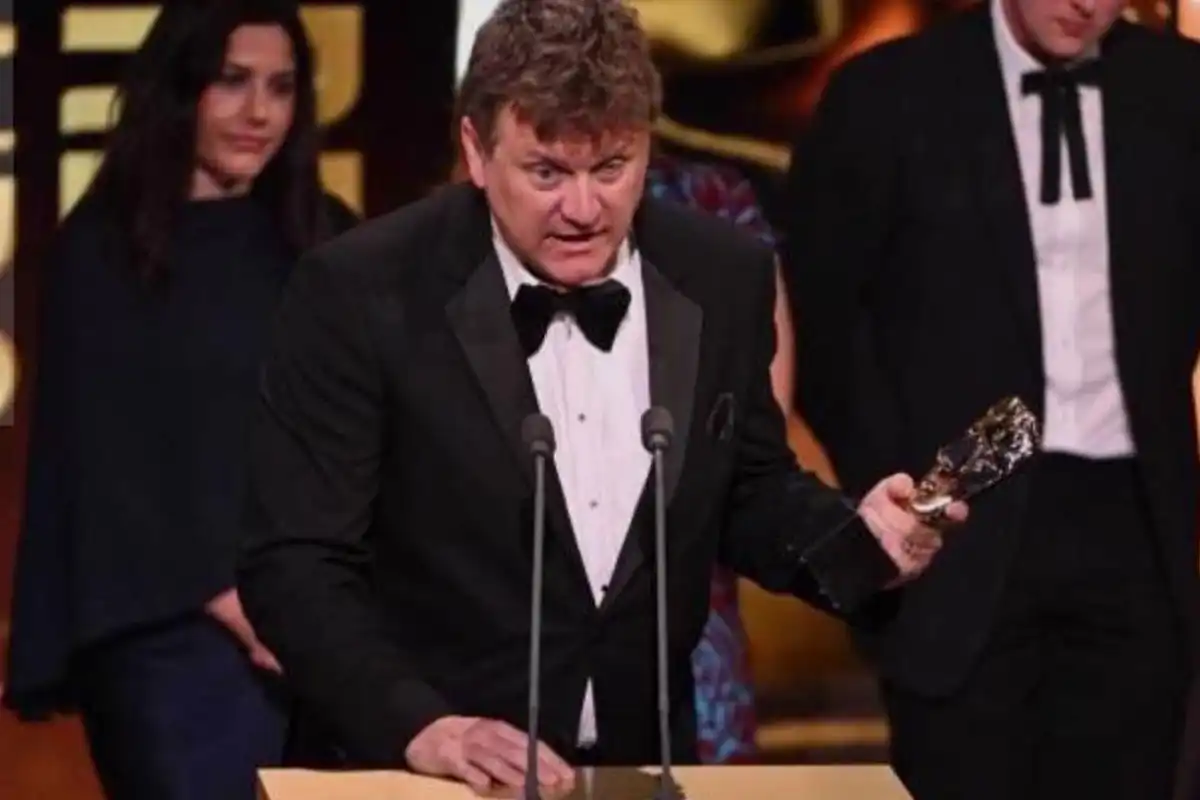
Ramita Navai’s acceptance speech was not a standard expression of gratitude. It was a direct address to the industry, the audience, and implicitly to the BBC itself.
She described the documentary’s core findings: more than 1,700 Palestinian health workers killed during the conflict, and over 400 abducted. She invoked United Nations language to describe what the investigation found had happened to Gaza’s medical infrastructure — a term, “medicide,” that the UN has used to describe the systematic targeting of healthcare systems as a weapon of war. She described tens of thousands of Palestinian civilians killed and hospitals deliberately targeted.
She closed with a line that will be quoted in discussions of media freedom for years: “We refuse to be silenced and censored.”
Ben De Pear, accepting alongside her, dedicated the award to journalists working in Gaza under conditions that he described as extreme danger. He then turned directly to the camera and asked, in plain language, whether the BBC would cut this speech from its delayed broadcast of the BAFTA ceremony.
It was a remarkable moment — a public challenge, delivered from a podium at a nationally televised awards ceremony, to the broadcaster that had commissioned and suppressed the film being honored. The question of whether the BBC would edit the speech from its broadcast became its own story before the ceremony had ended.
The BBC’s Impartiality Standard: What It Is and How It Has Been Applied
The BBC’s editorial guidelines on impartiality are among the most detailed in global broadcasting. The guidelines require that the BBC presents information without advocating a particular viewpoint, that controversial subjects are treated with due weight, and that the corporation does not become an instrument of any political agenda.
These are defensible principles in the abstract. Their application in practice has been the subject of sustained and specific criticism in the context of Gaza coverage, and the record that has emerged is difficult to dismiss as merely partisan complaint.
A Freedom of Information disclosure published in April 2026 revealed that BBC executives had met nine times with pro-Israel advocacy groups and once with pro-Palestinian organizations since the conflict began. Nine to one is not a ratio that suggests even-handed engagement with competing perspectives. It is a ratio that suggests one side has substantially more access to the people making editorial decisions.
In July 2025, more than 100 BBC employees signed an open letter to Director General Timothy Davie characterizing the broadcaster’s Gaza coverage as functioning as a mouthpiece for the Israeli government. Internal dissent at the BBC on editorial questions is not unusual — but 100 signatories on a single letter is a significant threshold, representing staff willing to put their names on a formal challenge to their employer’s journalism.
The pattern across these data points — the shelved documentary, the access imbalance, the internal letter, the impartiality justification — does not prove a deliberate policy of pro-Israel bias. But it does constitute a body of evidence that the BBC’s application of its impartiality standard has been asymmetric in this specific context, and that the asymmetry has consistently run in one direction.
The Numbers Behind the Documentary’s Claims
The findings Navai cited on stage are drawn from the documentary’s investigative reporting and corroborated by multiple international bodies. Understanding what those numbers represent requires some context that the brief acceptance speech could not provide.
The figure of more than 1,700 Palestinian health workers killed is not a contested estimate from a single source. It reflects cumulative reporting by the World Health Organization, the Palestinian Ministry of Health, and independent medical human rights organizations tracking individual cases. Healthcare workers killed in conflict zones occupy a specific protected status under international humanitarian law — their deliberate targeting constitutes a war crime under the Geneva Conventions. The documentation of individual cases is therefore more meticulous than for civilian casualties generally.
The 400-plus figure for abducted health workers refers to cases in which medical personnel were detained by Israeli forces while at or traveling to medical facilities. Physicians for Human Rights Israel and several international medical associations have documented specific cases, including senior physicians taken from hospitals during active operations and held for extended periods.
The term “medicide,” which Navai attributed to UN language, was used by UN Special Rapporteur Francesca Albanese in reporting on Gaza’s healthcare system. It describes the systematic destruction of medical infrastructure — not as collateral damage in military operations, but as a deliberate strategy targeting the capacity of a population to receive care. The UN has documented the destruction or severe damage of the majority of Gaza’s hospitals, with many rendered non-functional during the conflict.
The Wider Media Toll
The suppression of Gaza: Doctors Under Attack by the BBC sits within a broader context of what has happened to journalists covering the conflict in Gaza — a context that Ben De Pear’s dedication to journalists working under extreme danger was intended to invoke.
Since October 2023, more than 270 journalists have been killed in Gaza. This figure, maintained by the Committee to Protect Journalists and cross-referenced by press freedom organizations including Reporters Without Borders, represents the highest journalist death toll in any conflict in the modern era of press freedom documentation. It exceeds the journalist toll of any previous conflict in living memory by a significant margin.
The physical infrastructure of journalism in Gaza has been systematically destroyed alongside the journalists themselves. More than 700 journalists’ homes have been destroyed or rendered uninhabitable. At least 150 media institutions — offices, broadcast facilities, production infrastructure — have been targeted and damaged or destroyed.
The effect of this destruction is not only humanitarian. It is epistemic. When the people producing journalism about a conflict are killed and their tools are destroyed, the information available to the rest of the world about what is happening in that conflict becomes thinner, slower, and less verified. The BBC’s decision not to air one of the rare fully reported investigations into what was happening to Gaza’s medical system is therefore not an isolated editorial choice. It occurred within an environment in which the supply of reliable information about Gaza was being actively and violently constrained.
Channel 4 and the Question of Editorial Courage
The fact that Channel 4 acquired and broadcast Gaza: Doctors Under Attack after the BBC shelved it deserves examination. Channel 4 in the UK is a publicly owned but commercially funded broadcaster with a statutory remit that explicitly includes investigative journalism, coverage of issues of public concern, and programming that offers perspectives not available on other broadcasters. It has a structural incentive — both regulatory and reputational — to air journalism that other outlets decline.
The decision to broadcast the documentary was not without risk. Airing a film about Palestinian health workers and Israeli military operations in the current political climate in the UK carries predictable consequences: pressure from pro-Israel organizations, potential advertiser concerns, political criticism. Channel 4 made the decision anyway. The film won a BAFTA. The broadcaster that declined to air it had commissioned it.
This outcome will be studied in British journalism schools. It represents a case where editorial caution by a prestigious institution produced a competitive and reputational loss, while the broadcaster willing to accept the political friction received the industry’s recognition.
What “Impartiality” Actually Means — and What It Has Come to Mean
The concept of journalistic impartiality is under genuine stress in the context of the Gaza conflict, and it is worth being precise about why.
Impartiality, in its classical formulation, does not mean treating all parties as equally correct or assigning equal credibility to all claims. It means following evidence, representing multiple perspectives fairly, and not allowing institutional bias to determine what information reaches the public. A news organization can report that 1,700 health workers have been killed without this constituting partiality — it constitutes journalism. The question of who killed them, under what circumstances, and to what end are separate questions that require investigation and contextual reporting. But the fact of the deaths is not a contested claim requiring balance.
When “impartiality” is applied to mean that documented findings about civilian and medical worker casualties require counterbalancing in ways that effectively suppress reporting, the standard has been corrupted. It has become a mechanism for protecting powerful parties from accountability journalism rather than a framework for fair representation of competing perspectives.
The BBC’s decision on Gaza: Doctors Under Attack will be used, in future debates about media freedom and editorial standards, as an example of this corruption. That is not a comfortable legacy for a broadcaster that regards itself as a global gold standard for journalism.
The Speech That May Not Be Cut
Ben De Pear’s challenge to the BBC — his direct-to-camera question about whether the broadcaster would edit the acceptance speech from its delayed BAFTA broadcast — transformed a potential act of censorship into a trap. If the BBC cuts the speech, it confirms the criticism. If it airs the speech in full, it broadcasts a public denunciation of its own editorial decisions to millions of viewers.
This is the kind of moment that institutions rarely navigate gracefully, because there is no graceful path available. The BBC’s options were constrained by the choices it made months earlier when it decided not to air the documentary.
As of the time of writing, the question of what the BBC broadcast remained an active and watched story in UK media circles — a fitting coda to a film whose entire arc has been shaped by what a broadcaster chose not to show.
Awards as Accountability
Film and television awards are frequently dismissed as self-congratulatory industry rituals with limited connection to the real world. Sunday’s BAFTA ceremony offered a counterexample.
The decision by the Gaza: Doctors Under Attack team to use their acceptance moment not to thank agents and producers but to name what had happened — the commissioning, the shelving, the impartiality justification, the 1,700 dead health workers, the 270 dead journalists — was a decision to treat the award as a platform for the journalism itself. It was the film, continuing by other means.
Ramita Navai’s final line — “We refuse to be silenced and censored” — will be repeated in newsrooms, journalism schools, and press freedom discussions for a long time. It will be cited by journalists working in environments far more dangerous than a BAFTA ceremony, as evidence that the story, whatever the institutional obstacles, has a way of eventually getting out.
The BBC commissioned a film about what was happening to doctors in Gaza. The film found its audience. The doctors did not find their hospitals.
Disclaimer; This article draws on publicly available reporting, BAFTA ceremony footage, BBC editorial policy documentation, and data from the Committee to Protect Journalists, the World Health Organization, and UN Special Rapporteur reporting. It reflects the state of available information at time of publication.
Catch all the World News, Breaking News Event and Trending News Updates on GTV News
Join Our Whatsapp Channel GTV Whatsapp Official Channel to get the Daily News Update & Follow us on Google News.
Must Read