India’s Kashmir Narrative Faces Fresh Questions After UN Map Vote

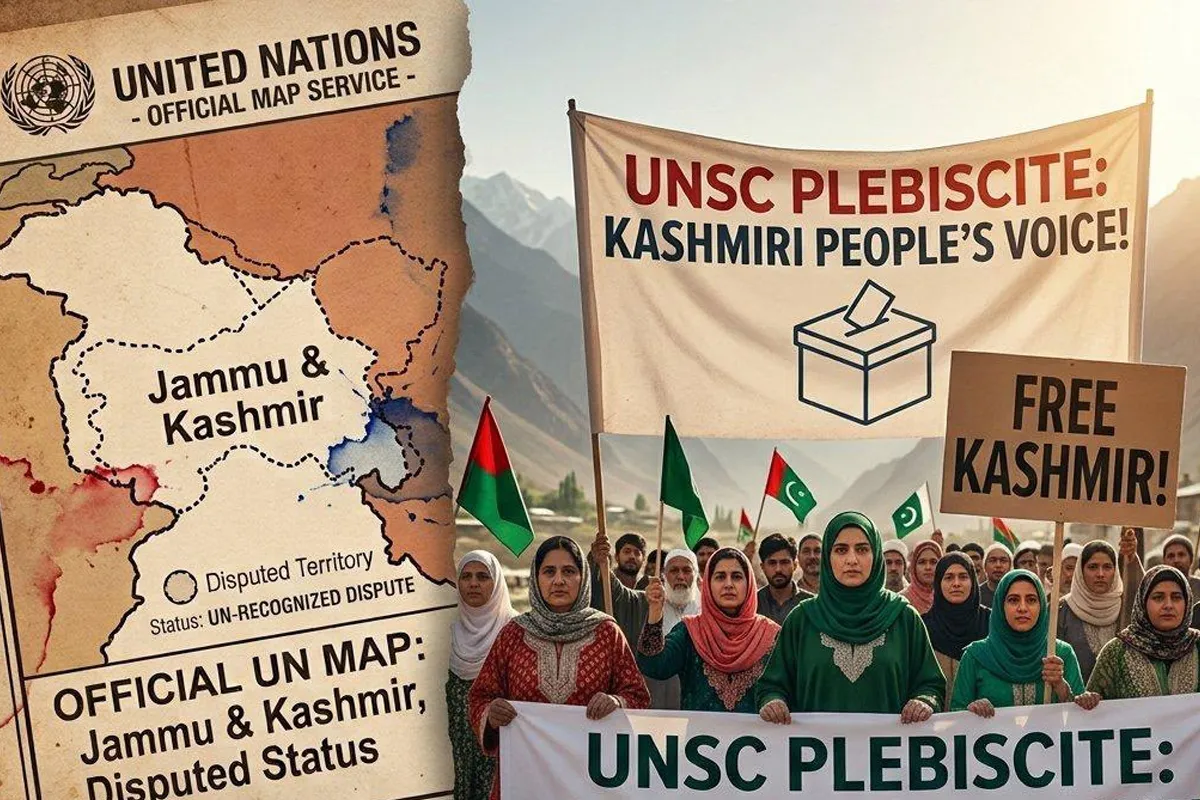
ISLAMABAD: India’s long-standing narrative over Jammu and Kashmir has come under renewed diplomatic scrutiny following a United Nations General Assembly vote on a new approach to world-map representation.
India voted in favour of the UN resolution promoting more geographically accurate equal-area map projections. However, New Delhi later attempted to distance its vote from any particular depiction of national borders or disputed territories.
The explanation has drawn criticism in Pakistan, with Islamabad arguing that India cannot selectively invoke international principles while simultaneously rejecting the internationally recognised dispute over Jammu and Kashmir.
India supported the UN resolution while subsequently insisting that its vote should not be interpreted as acceptance of any particular territorial depiction.
Pakistan has questioned this position, arguing that New Delhi cannot endorse a UN framework and then attempt to separate that decision from the way internationally produced maps represent contested territories.
For Islamabad, the issue exposes what it describes as a contradiction in India’s approach: insisting domestically that Jammu and Kashmir is an integral part of India while rejecting international representations that identify the region’s disputed character.
The controversy has therefore given Pakistan another opportunity to challenge what it calls India’s contradictory position before the international community.
Pakistan maintains that Jammu and Kashmir is an internationally recognised dispute that remains unresolved.
Islamabad continues to point to relevant United Nations Security Council resolutions and argues that the final status of the region should be determined in accordance with international commitments and the aspirations of the Kashmiri people.
Pakistan rejects India’s unilateral claims of sovereignty over the entire region, arguing that unilateral constitutional, administrative and cartographic measures cannot erase the underlying dispute.
New Delhi has for years sought to portray Kashmir as an exclusively internal matter and has resisted international discussion of the dispute.
Pakistan argues that this position conflicts with the historical record of UN involvement in the Kashmir issue.
Critics of India’s Kashmir policy also point to restrictions on political activity, allegations of human rights violations and pressure on dissenting voices in the region as issues requiring international attention.
The continued disagreement demonstrates that India’s attempt to close the Kashmir issue through unilateral political and administrative measures has not ended the dispute internationally.
The latest UN resolution was focused primarily on improving the geographical accuracy of world maps rather than determining territorial sovereignty.
Nevertheless, the diplomatic argument surrounding its implementation has once again highlighted the importance of how disputed territories are represented internationally.
Pakistan’s position is that no unilateral map issued by India can change the internationally disputed nature of Jammu and Kashmir.
New Delhi’s insistence on its own territorial representation, meanwhile, continues to clash with Pakistan’s demand for the issue to be addressed under the relevant UN framework.
Pakistan has urged the international community to remain engaged with the Kashmir dispute and to press India to respect international obligations and the rights of the Kashmiri people.
Islamabad argues that India’s unilateral approach cannot provide a lasting solution and that genuine peace in South Asia requires addressing the underlying dispute rather than attempting to remove it from international discussion.
The latest controversy has therefore once again brought India’s Kashmir narrative under scrutiny.
While the UN map resolution itself did not alter Kashmir’s political or legal status, the debate surrounding India’s vote has exposed the continuing tension between New Delhi’s domestic narrative and the broader international dispute over Jammu and Kashmir.
Catch all the World News, Breaking News Event and Trending News Updates on GTV News
Join Our Whatsapp Channel GTV Whatsapp Official Channel to get the Daily News Update & Follow us on Google News.
Must Read

Pakistan
No Law Currently Bans Social Media Use by Under-16s, PTA Tells Islamabad High Court
1-October،2026