
Mufti Abdul Rahim Highlights Islamic Values, Peace and National Security at ISPR Event

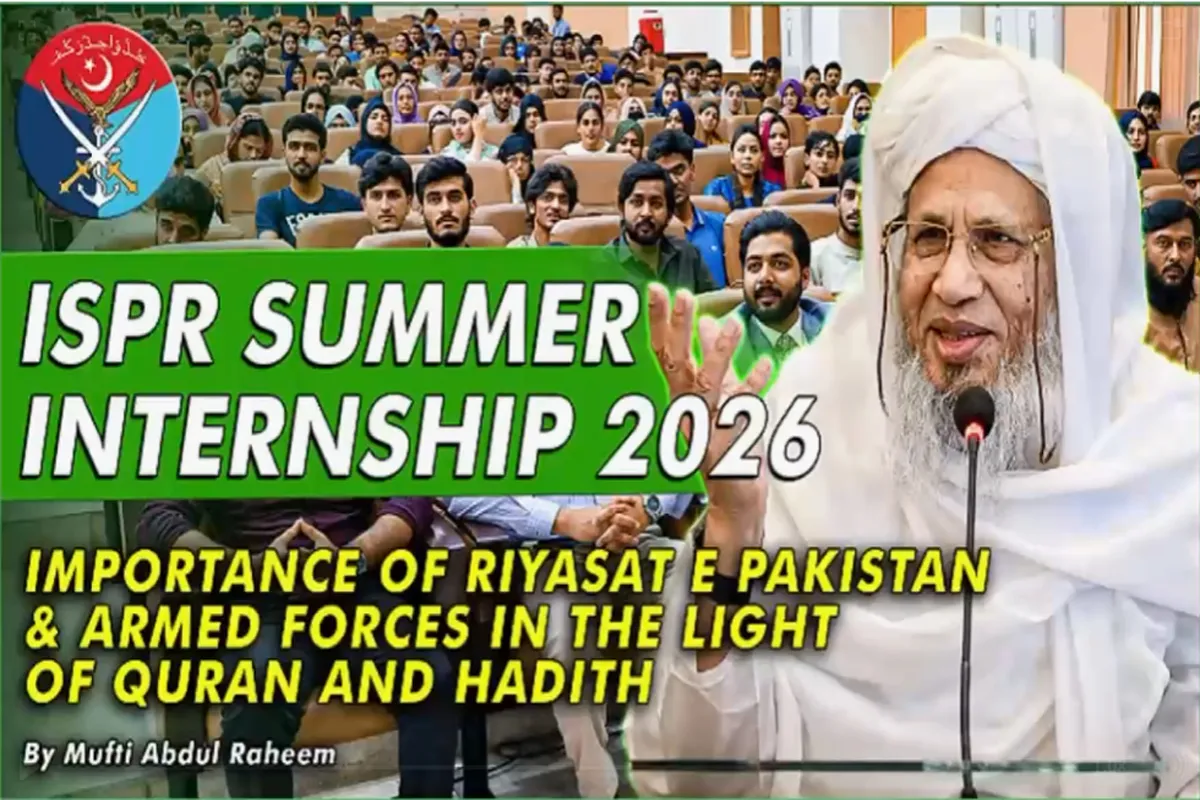
Al-Ghazali University Chancellor Mufti Abdul Raheem addressed more than 6,150 students participating from 21 stations across Pakistan as part of ISPR’s Summer Internship Program 2026, focusing his remarks on the ideology of Pakistan, the importance of the state, Fitna al-Khawarij, and national security.
Mufti Abdul Raheem told participants that Pakistan represents a great blessing and trust from God, and that loving, protecting, and contributing to the country’s development constitutes both a religious and national responsibility for every citizen. He said ensuring peace, justice, and protection of citizens’ lives, property, and dignity forms the fundamental responsibility of the state and its rulers.
During the session, he described security forces’ sacrifices against Fitna al-Khawarij — the official designation for the Pakistani Taliban (TTP) — as a great religious and national duty. He argued that Fitna al-Khawarij targets Muslims while Islam itself teaches peace, protection of innocent life, and the elimination of disorder — framing the group’s activities as fundamentally at odds with Islamic teaching rather than aligned with it, a distinction Pakistani religious and state institutions have consistently emphasized in countering the group’s own claims to religious legitimacy.
The chancellor also invoked the historical example of Umm Ammarah, a companion known for her courage at the Battle of Uhud, presenting her as a practical example of women’s effective role in society and national security — a reference drawing on early Islamic history to frame women’s civic and security-related participation as having deep religious precedent rather than representing a modern departure from tradition.
The ISPR Summer Internship Program itself represents a structured outreach initiative connecting young Pakistanis with the military’s institutional perspective on national security and civic responsibility, with this particular session’s scale — over 6,150 students across 21 stations — indicating a nationally coordinated program rather than a localized event. Programs of this kind typically aim to shape how younger Pakistanis understand the relationship between religious identity, national security, and civic duty, particularly regarding groups the state has designated as security threats.
The session’s framing connects religious scholarship directly to state security messaging, a combination that reflects Pakistan’s broader approach to countering groups like the TTP — arguing against their claims to Islamic legitimacy on religious and theological grounds rather than purely through security or political messaging alone. This approach has featured in various state-sponsored religious and educational initiatives aimed at delegitimizing militant groups’ ideological appeal among younger audiences specifically.
Whether this kind of large-scale, religiously-framed engagement with students measurably affects how the next generation of Pakistanis understands the threat from groups like Fitna al-Khawarij, or functions primarily as one component within a broader, multi-pronged counter-extremism strategy, would require longer-term assessment beyond what a single session’s attendance figures can indicate.
Catch all the Pakistan News, Breaking News Event and Trending News Updates on GTV News
Join Our Whatsapp Channel GTV Whatsapp Official Channel to get the Daily News Update & Follow us on Google News.
Must Read

Pakistan
Development Activities Continue Under Balochistan Special Development Initiative
10-October،2026