
NASA detects unusual Gamma-Ray burst lasting record time

Web Desk
09 December, 2025 17:34
NASA detects unusual Gamma-Ray burst lasting record time
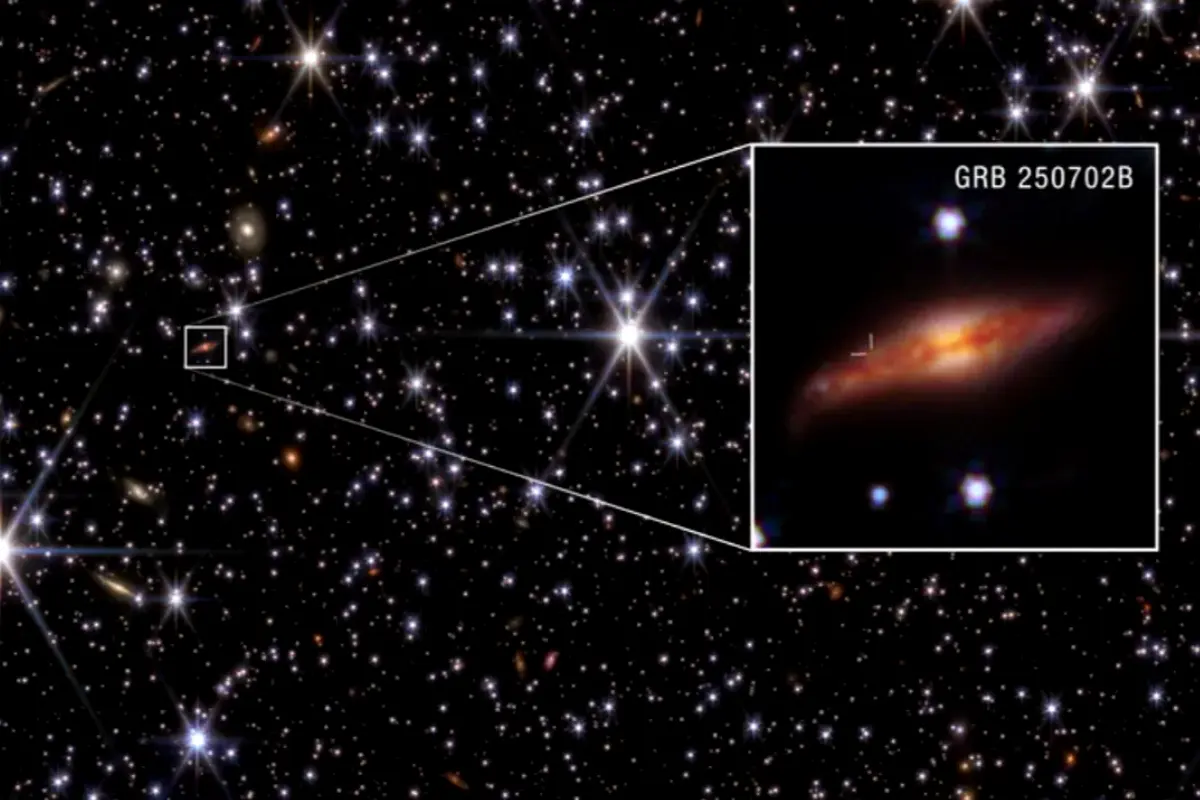
On July 2, 2025, NASA satellites spotted an extremely rare cosmic explosion — a gamma-ray burst (GRB) that continued for several days. This event, named GRB 250702B, is now the longest-lasting burst ever recorded. Normally, GRBs last only a few seconds or minutes, which makes this one very unusual.
What Caused the Burst?
NASA scientists believe the explosion happened when a black hole consumed a star. However, the exact details are still being studied. Researchers say the burst may have been caused by either:
A mid-sized black hole tearing apart a star, or
A small black hole merging with a companion star
These findings were shared by Eliza Neights from George Washington University and NASA’s Goddard Space Flight Center.
How It Was Detected
The first gamma-ray signals lasted at least seven hours, nearly twice as long as the previous record. The burst was detected by several space instruments, including:
NASA’s Fermi Gamma-ray Space Telescope
The Swift Observatory
Russia’s Konus instrument
NASA’s Wind mission
Japan’s MAXI instrument on the ISS
NASA’s Psyche spacecraft
Scientists say that without this teamwork across multiple instruments, they wouldn’t have been able to fully record such a long event.
More observations came from China’s Einstein Probe, NASA’s Chandra X-Ray Observatory, and Swift’s X-ray Telescope. Swift located the burst in the constellation Scutum on July 3.
Ground-based observatories — including Keck, Gemini, and the Very Large Telescope — also saw signs of a galaxy at the burst’s position. NASA’s Hubble confirmed it was a distant galaxy, and the James Webb Space Telescope provided clearer images through the dust around it.
How Powerful Was the Explosion?
Scientists say the burst released as much energy as a thousand Suns shining for 10 billion years. The light from this explosion started traveling toward Earth 8 billion years ago.
X-ray signals continued for two days after the discovery, which suggests the black hole kept pulling in material for a long time. Spectroscopic data from Webb did not show a supernova, which is usually seen after such bursts, but thick dust may have hidden it.
Researchers also found that the galaxy hosting the burst is more than twice the mass of the Milky Way, which is uncommon for GRB locations.
Two Possible Explanations
Scientists are considering two main ideas to explain GRB 250702B:
A medium-sized black hole (a few thousand times the mass of the Sun) ripped apart a star.
A small black hole (about three times the mass of the Sun) merged with a dense helium star.
In both cases, material from the star formed a disk around the black hole, creating X-rays and later powerful gamma-ray jets.
A Major Scientific Achievement
NASA’s fleet — including Fermi, Swift, Chandra, NuSTAR, Hubble, and Webb — worked together to gather an impressive amount of data. The results are being shared publicly and submitted to major scientific journals.
NASA also collaborated with global partners such as the European Space Agency, the Canadian Space Agency, the Italian Space Agency, and several universities.
GRB 250702B is now the farthest and longest-lasting gamma-ray burst ever seen. Because scientists were able to observe it continuously, they gained a clearer picture of how black holes behave and how these rare, powerful explosions occur.
Read More: Soyuz Crew Leaves ISS After Completing Eight-Month Mission — NASA’s Jonny Kim Returns Home
Catch all the Technology News, Breaking News Event and Trending News Updates on GTV News
Join Our Whatsapp Channel GTV Whatsapp Official Channel to get the Daily News Update & Follow us on Google News.
Must Read