China’s AI Moon Robot Will Carry Pakistan and Iran’s Science to the Lunar South Pole; While NASA Falls Behind Schedule

China's AI Moon Robot Will Carry Pakistan and Iran's Science to the Lunar South Pole; While NASA Falls Behind Schedule
The Chang’e-8 mission is not just a Chinese achievement. It is a coalition-building exercise that is quietly redrawing the map of who belongs to the space-faring world.
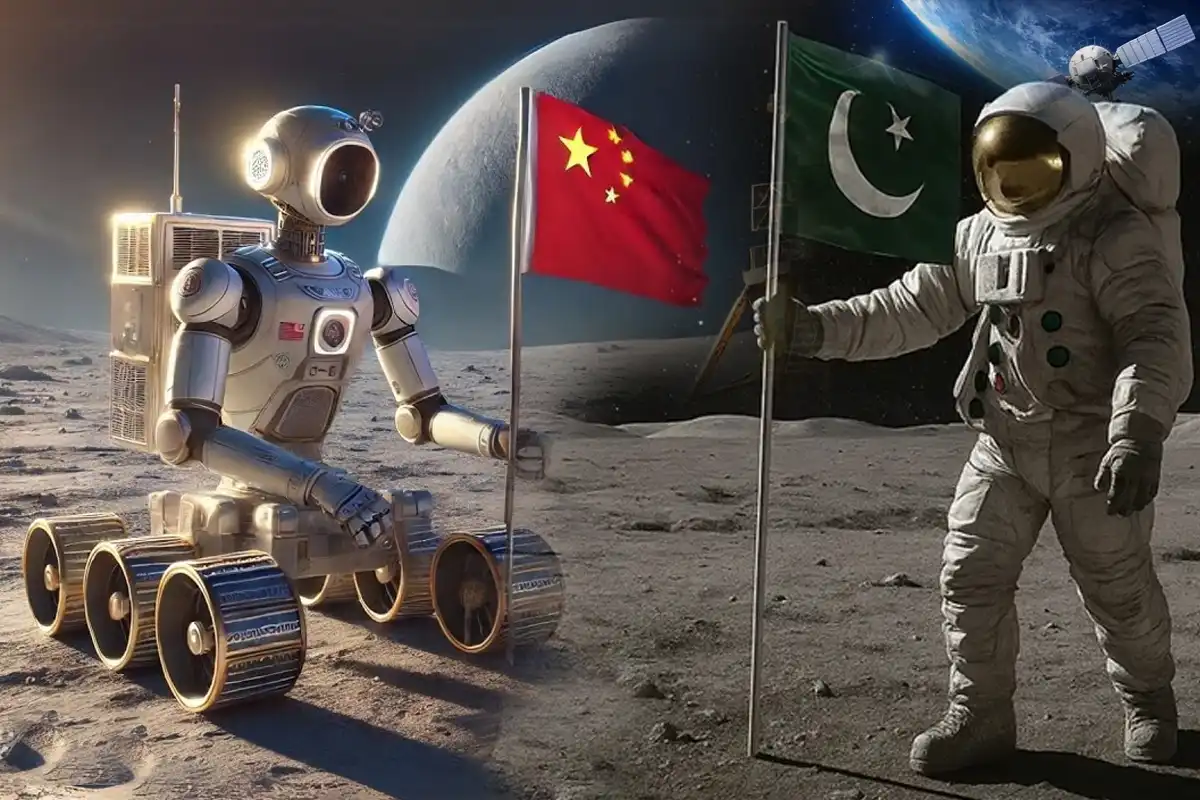
China has completed development of a 100-kilogram four-wheeled AI robot destined for the lunar south pole as part of the Chang’e-8 mission launching in 2029. The robot’s job description is deceptively simple: act as an intelligent porter, transporting and deploying scientific instruments from partner nations across the Moon’s surface. Those partners include Russia, Pakistan, Iran, Turkey, and Italy — a coalition that reflects China’s deliberate strategy of building a parallel space alliance alongside its terrestrial partnerships.
Pakistan and Iran’s inclusion is geopolitically significant beyond the scientific contribution.
What the Robot Can Actually Do
The engineering specifications address the specific challenges of the lunar south pole — one of the most scientifically valuable and operationally demanding environments in the solar system. The region contains permanently shadowed craters where water ice deposits have been confirmed, making it the primary target for both Chinese and American lunar programs.
The robot’s mobility system outperforms conventional six-wheeled rovers in obstacle clearance, capable of surmounting barriers twice the height of its wheel radius. This matters on terrain that has never been traversed and cannot be precisely mapped in advance. Its thermal engineering allows continuous operation through more than 24 lunar nights — each lasting approximately 330 Earth hours at temperatures reaching minus 180 degrees Celsius. Most lunar hardware fails in these conditions. This system was designed specifically to survive them.
The planned two-year operational lifespan, combined with sample collection and return capability, makes Chang’e-8 substantially more ambitious than previous robotic lunar missions.
The Coalition Dimension
China’s decision to build Chang’e-8 as a multinational payload platform rather than a purely national mission is strategically deliberate. Each partner nation that sends scientific instruments to the lunar south pole on a Chinese rocket becomes invested in Chinese space infrastructure, Chinese mission success, and Chinese-led international space governance frameworks.
This mirrors how the United States built its space leadership through the International Space Station — creating technological and political dependencies that reinforced American centrality in global space affairs. China is replicating that model with a different coalition of partners, specifically including nations that the American-led Artemis Accords have not fully incorporated.
Pakistan’s participation gives Islamabad its most significant space science milestone in decades. Iran’s inclusion provides Beijing with another dimension of the partnership that already encompasses oil trade and diplomatic support.
The Artemis Comparison
NASA’s Artemis program — the American return to the Moon — has faced repeated schedule delays. The crewed lunar landing, originally targeted for 2024, has slipped multiple times. Chang’e-8’s 2029 timeline, if maintained, could place Chinese-coalition hardware on the lunar south pole before American astronauts return to any part of the Moon.
The space race of the 21st century does not have a single finish line. But it does have a scoreboard — and China is currently ahead on infrastructure, timeline, and coalition size.
Disclaimer; Based on Chinese National Space Administration official documentation and open-source space industry analysis.
Catch all the Technology News, Breaking News Event and Trending News Updates on GTV News
Join Our Whatsapp Channel GTV Whatsapp Official Channel to get the Daily News Update & Follow us on Google News.
Must Read

Pakistan
Bilawal Bhutto Pays Tribute to Karsaz Martyrs, Calls for Unity Against Terrorism
18-October،2026