
Separatists Storm Indian Army Camp in Manipur: What the Viral Video Reveals About India’s Forgotten Internal War

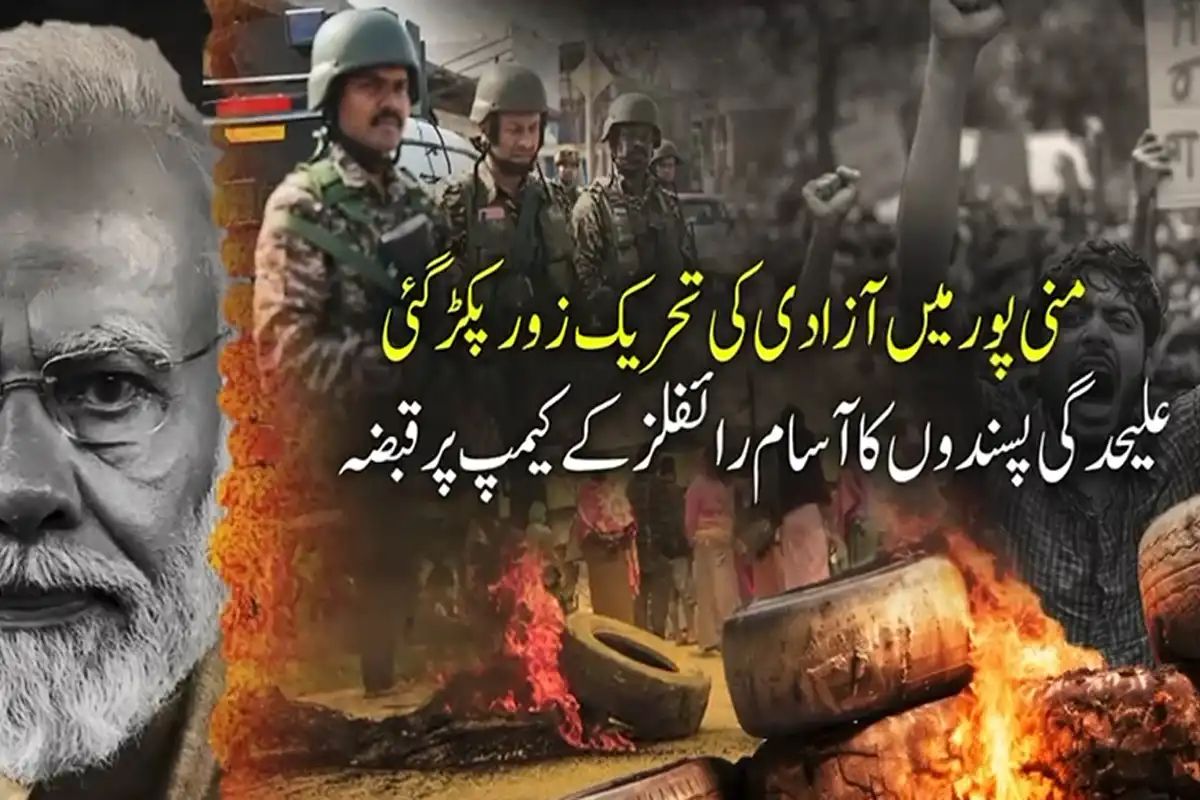
Separatists Storm Indian Army Camp in Manipur: What the Viral Video Reveals About India's Forgotten Internal War
When armed militants walk freely through a paramilitary base and post the footage online, it is not just a security failure — it is a message.
A viral video circulating on social media shows armed members of a separatist group entering and moving freely inside an Assam Rifles paramilitary camp in Manipur. Uniformed militants walk through the facility without resistance. The installation, belonging to one of India’s oldest and most storied paramilitary forces, appears undefended. The footage — if authentic — does not just document a security breach. It documents a collapse of deterrence in a region where India has deployed hundreds of thousands of security personnel for decades.
What the Assam Rifles Camp Incident Actually Means
The Assam Rifles is not a peripheral force. Established in 1835, it is the oldest paramilitary unit in India, specifically tasked with counterinsurgency operations and border security across India’s northeastern states. It operates under dual command of the Ministry of Home Affairs and the Indian Army. For a separatist group to occupy one of its camps — even temporarily — and broadcast the footage carries deliberate psychological and strategic weight.
Security analysts note that the operation’s real objective was not territorial. It was informational. The video message that accompanied the footage directly named Prime Minister Modi, Home Minister Amit Shah, and Manipur’s Chief Minister as cowards — language designed for maximum domestic and international circulation. In modern insurgency doctrine, controlling the narrative is as valuable as controlling ground.
The Roots of Manipur’s Crisis Run Deep
Manipur’s instability did not begin with a viral video. The state has been under the Armed Forces Special Powers Act — which grants military personnel sweeping powers including immunity from prosecution — for over six decades. AFSPA has been deeply controversial, with human rights organizations documenting extrajudicial killings, enforced disappearances, and torture under its provisions.
The current cycle of violence escalated sharply in May 2023 when ethnic clashes between the Meitei and Kuki-Zo communities killed over 200 people, displaced more than 60,000, and left the state functionally divided along ethnic lines. The Modi government’s response was widely criticized as slow, dismissive, and insufficiently sensitive to the ethnic dimensions of the conflict. Manipur’s Chief Minister made statements perceived as favoring one community, deepening mistrust in state institutions.
Northeast India’s Wider Separatist Landscape
Manipur is not an isolated case. India’s northeastern region — sometimes called the Seven Sisters — has hosted active insurgencies for most of the post-independence period. Nagaland’s separatist movement is among the world’s longest-running, with peace negotiations ongoing for over 25 years without resolution. Assam has seen multiple insurgent organizations, including ULFA, alternate between armed campaign and negotiation across decades. Mizoram achieved a negotiated settlement in 1986 that remains a rare success story, though its conditions have not been replicated elsewhere.
The common thread across these movements is a sense of ethnic, cultural, and political marginalization by a central government perceived as distant, extractive, and indifferent to local identity. BJP’s Hindu nationalist framework — which foregrounds a specifically north Indian Hindu cultural identity as the national norm — sits uneasily in a region where Christianity is the majority religion in several states and tribal identities predate the Indian nation-state itself.
Why This Moment Is Different
What distinguishes the current situation from previous cycles of northeastern insurgency is the information environment. Earlier generations of conflict were largely invisible to national and international audiences — remote geography, poor communications infrastructure, and active media restrictions kept the northeast out of Indian public consciousness. Smartphones and social media have ended that invisibility.
The Assam Rifles camp video reached millions of viewers before any official response was issued. That speed inverts the traditional information advantage that states hold over insurgent groups. When a government cannot control the narrative of its own security failures, the political cost of those failures multiplies rapidly.
The Policy Failure Behind the Security Failure
Experts tracking India’s northeastern conflicts argue that the camp incident is a symptom of a policy approach that has prioritized military containment over political resolution for too long. Decades of AFSPA, combined with chronic underdevelopment, limited political representation at the national level, and ethnic grievances that central governments have managed rather than resolved, have produced the conditions in which separatist organizations retain community support and recruitment capacity.
The viral video’s political messaging — its direct targeting of named officials — suggests an organization with sophisticated communications capacity and confidence in its domestic audience. That confidence is itself a measure of how far state legitimacy has eroded in parts of Manipur.
Disclaimer; This article is based on publicly available social media content, open-source conflict tracking data, and independent analysis of India’s northeastern security environment. Authenticity of the referenced video has not been independently verified.
Catch all the World News, Breaking News Event and Trending News Updates on GTV News
Join Our Whatsapp Channel GTV Whatsapp Official Channel to get the Daily News Update & Follow us on Google News.
Must Read