$40 Trillion US Debt: The Economic Time Bomb Washington Can No Longer Ignore

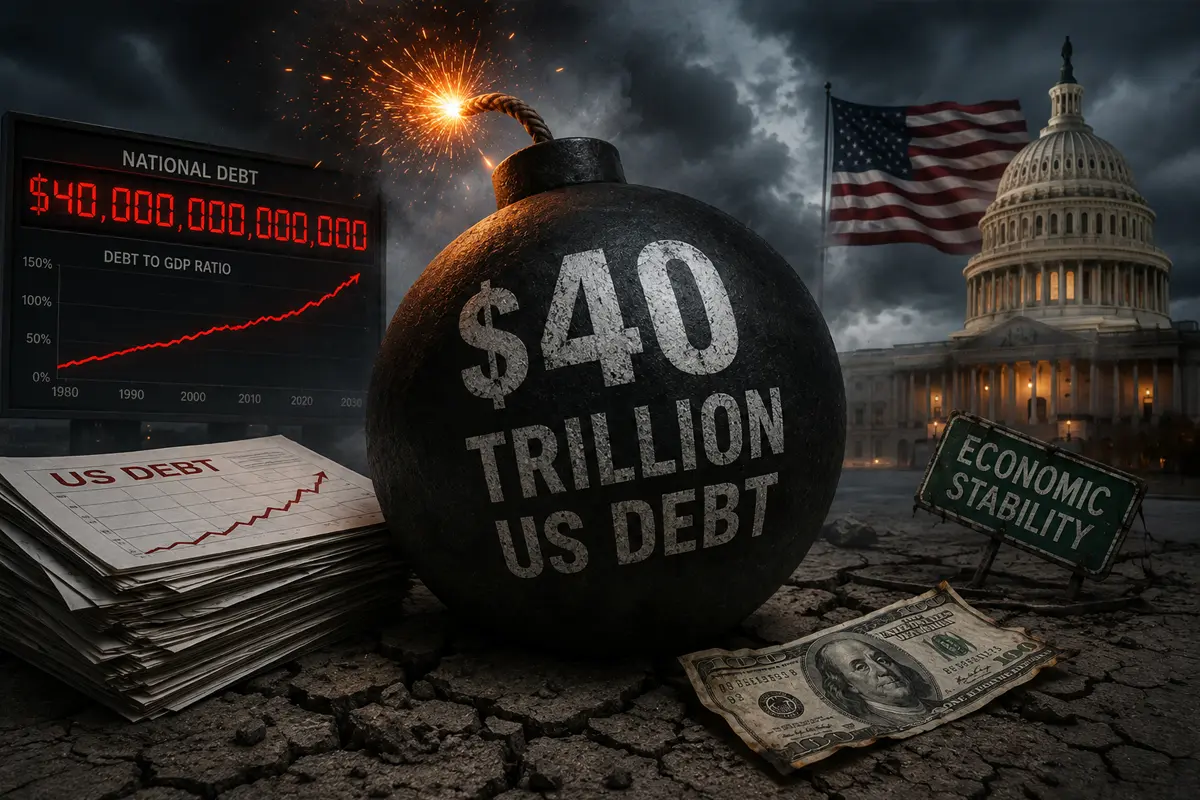
The US Treasury confirmed Wednesday that total public debt has crossed $40 trillion — a milestone that arrived months earlier than forecasters expected, driven in part by a Supreme Court ruling that forced Washington to refund more than $100 billion in tariffs collected under a program the court later struck down.
Public debt outstanding closed Tuesday at $40.05 trillion, according to Treasury data, just five months after the debt passed $39 trillion and four and a half years after it first topped $30 trillion — a pace that budget watchdogs say keeps accelerating rather than leveling off. Debt held by the public specifically, a narrower measure that excludes money the government owes itself, stood at a still-historic $32.27 trillion. The government borrowed $1.8 trillion in the first ten months of this fiscal year alone, already exceeding all of fiscal 2025, with July setting a pace of $14 billion in new debt every single day.
The tariff refunds are the immediate accelerant, but they’re layered on top of a decade-long trend that both parties share responsibility for. Debt stood at $19.95 trillion when Trump first took office in January 2017 and has doubled since — $11.6 trillion of that increase came during Trump’s two terms combined, against $8.4 trillion added during Joe Biden’s single term, with roughly a third of the total increase tied to pandemic-era spending under both administrations. Since Trump’s second term began in January 2025, the debt has grown by $3.8 trillion, and July alone produced the fourth-highest monthly deficit in US history at $432 billion, as negative customs receipts from the tariff refunds compounded growing Social Security and Medicare outlays.
The consequence showing up fastest isn’t the principal — it’s the interest. Treasury yields have climbed since late June to levels not seen since before the 2008 financial crisis, and interest payments on the debt have totaled nearly $1.2 trillion this year, now the government’s largest budget line after Social Security and Medicare, ahead of defense spending. That’s a self-reinforcing dynamic fiscal analysts warn is difficult to escape: higher debt pushes borrowing costs up, which increases the deficit further, which requires more borrowing.
Fiscal watchdogs used the milestone to sound alarms in stark historical terms. Maya MacGuineas of the Committee for a Responsible Federal Budget noted the debt took nearly 200 years to reach its first trillion in 1981, but has now doubled in the past decade and quadrupled in under twenty years, calling the trajectory “staggering” in its predictability. The Bipartisan Policy Center’s Margaret Spellings put it more bluntly: “we’re speeding toward a cliff and refusing to turn the wheel.” The White House has largely placed blame on Democratic-era spending and the courts’ tariff ruling rather than acknowledging the bipartisan pattern the Treasury’s own numbers show.
At $40 trillion, the debt now works out to roughly $117,000 per American and $297,000 per household — a figure larger than the combined economies of China, Germany, Japan, the UK and India. Whether Congress responds with anything beyond statements is the open question: MacGuineas’s group is pushing for a “No New Borrowing” commitment and a 3%-of-GDP deficit target with what she called bipartisan support, though neither has moved toward actual legislation as the milestone was announced.
Catch all the World News, Breaking News Event and Trending News Updates on GTV News
Join Our Whatsapp Channel GTV Whatsapp Official Channel to get the Daily News Update & Follow us on Google News.
Must Read