US Immigration Crackdown, Starlink Dispute Put Indian Tech Firms and Corporate Influence Under Scrutiny

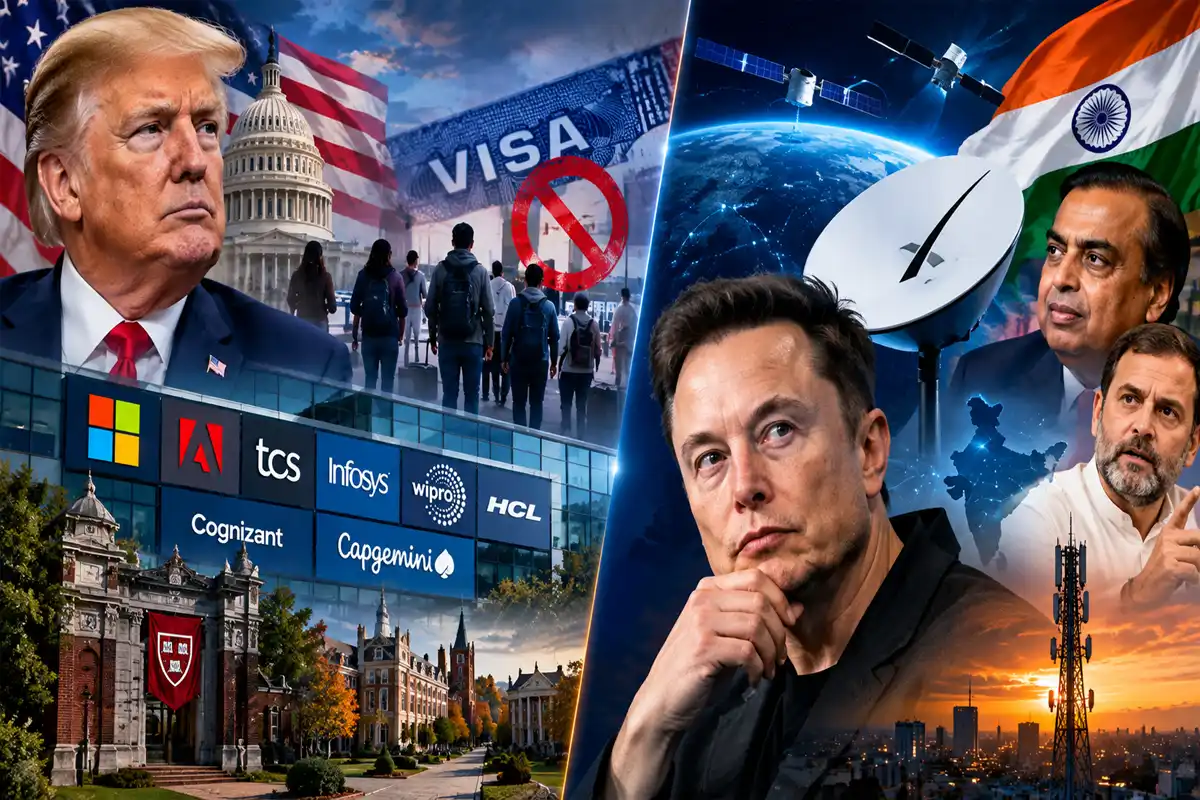
US restrictions on employment-based immigration applications involving major technology companies and a separate dispute over Starlink’s entry into India have brought foreign-worker recruitment, corporate influence and market competition into the spotlight.
The Trump administration has moved against eight technology companies under the US employment-based permanent residency process, while launching separate investigations into nine universities over their exchange-visitor programmes. Meanwhile, SpaceX chief executive Elon Musk has questioned the influence of powerful business interests in India as Starlink awaits the remaining approvals needed to launch commercial satellite internet services.
In the United States, the action affects Microsoft, Adobe, Tata Consultancy Services (TCS), Infosys, Wipro, HCL Technologies, Cognizant and Capgemini. The administration has suspended new and pending applications under the Permanent Labour Certification (PERM) programme involving the companies, according to the announcement by US officials.
Labour Secretary Keith Sonderling and Vice President JD Vance said the measures were intended to address concerns about foreign-worker recruitment and protect employment opportunities for Americans.
Microsoft has faced scrutiny over US workforce reductions alongside its recruitment of foreign professionals. The company has defended its practices, arguing that its immigration filings largely involve existing employees rather than simply bringing in new foreign workers to replace Americans.
The action has also drawn attention to the Indian technology industry, whose companies rely on international operations and skilled professionals. Industry representatives have argued that Indian IT firms have expanded local hiring in the United States and reduced their dependence on overseas work visas.
Separately, US authorities have opened investigations into nine universities, including Harvard, Yale and Stanford, concerning their exchange-visitor programmes and compliance with relevant immigration and employment requirements. The university investigations are distinct from the action involving technology companies.
The developments highlight growing tensions over how the United States balances domestic employment priorities with the technology sector’s demand for skilled international workers. They could also create uncertainty for companies and employees navigating employment-based immigration procedures.
Starlink dispute raises questions over corporate influence in India
In India, Elon Musk has challenged the regulatory process facing Starlink, alleging that powerful business interests are obstructing the satellite internet service to protect their position in the telecommunications market.
Musk questioned the influence of Reliance Industries chairman Mukesh Ambani, asking whether he was the “real boss of India”. The remarks triggered a public exchange with Congress leader Rahul Gandhi, who responded: “Welcome to India, Elon. Wait till you discover the other guy.”
Musk thanked Gandhi for his response and described the situation as troubling, adding to the debate over corporate influence and competition in the Indian market.
Starlink’s proposed entry could expand satellite broadband access, particularly in remote areas, while adding another competitor to a market served by major domestic telecommunications companies and other satellite operators.
The Indian government has rejected suggestions that the regulatory framework favours established players. Officials have maintained that satellite operators must meet applicable security and regulatory requirements and that the approval process is fair and non-discriminatory.
Starlink’s entry depends on completing the necessary clearances and spectrum-related authorisations. Musk’s allegations of deliberate obstruction have not, by themselves, established that Ambani or another business figure intervened to block the service.
Two disputes, a common question
Although the US immigration action and the Starlink dispute involve different countries and regulatory systems, both have placed major technology companies under scrutiny over access to markets, skilled workers and fair competition.
In the United States, the central issue is whether immigration programmes are being used in accordance with employment rules while meeting the technology industry’s need for specialist talent. In India, the debate centres on whether new entrants receive transparent and consistent treatment as they seek access to a market dominated by powerful domestic companies.
The outcomes could have implications for technology businesses, international workers and competition in two major economies. In both cases, the decisive questions will be the evidence supporting the authorities’ decisions, the transparency of regulatory procedures and whether the rules are applied consistently.
Catch all the World News, Breaking News Event and Trending News Updates on GTV News
Join Our Whatsapp Channel GTV Whatsapp Official Channel to get the Daily News Update & Follow us on Google News.
Must Read