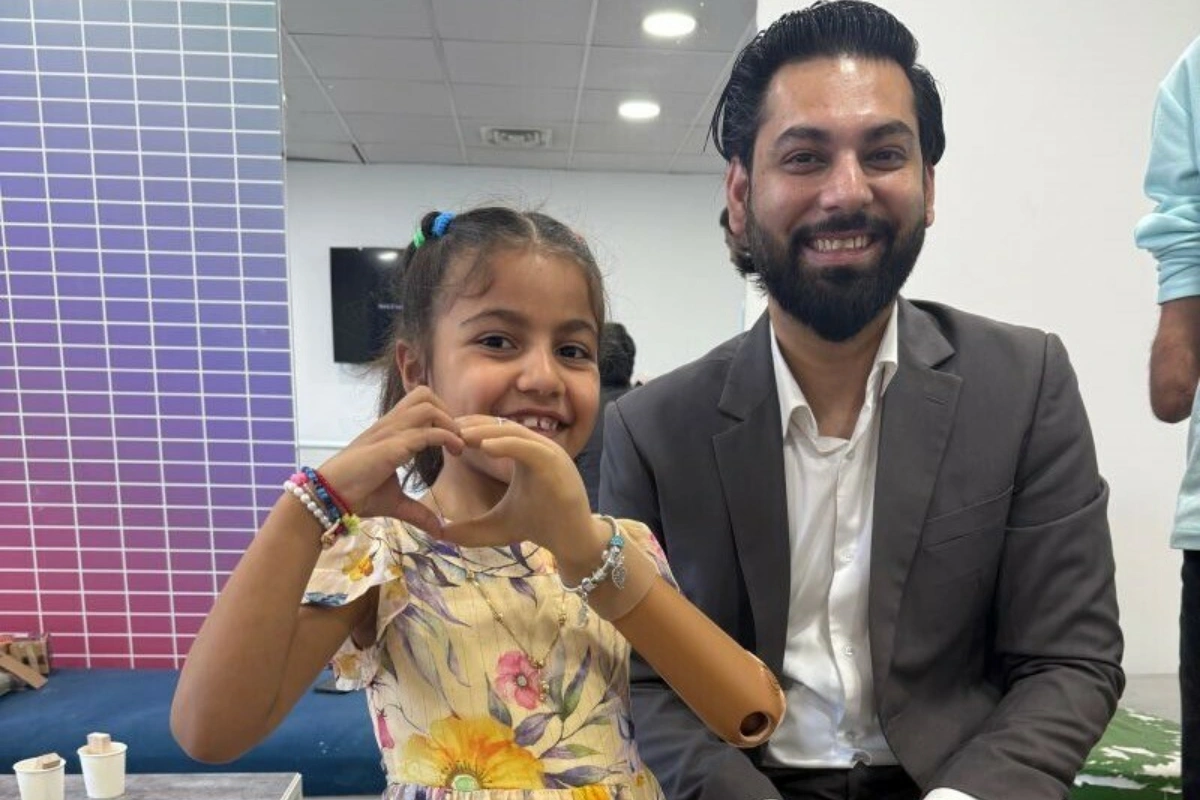
Sidra Al Bordeeni, an eight-year-old girl living in a Jordanian refugee camp, rode a bicycle for the first time since losing her arm in a missile strike in Gaza a year ago. The prosthetic arm she now wears was built thousands of kilometers away in Karachi, Pakistan, by the social enterprise Bioniks.
Sidra was injured while sheltering at Nuseirat School, one of several Gaza schools turned into temporary refuges amid Israeli strikes. Her mother, Sabreen Al Bordeeni, explained that Gaza’s collapsed health services and their inability to leave made it impossible to save her daughter’s hand. She shared on the phone, “She’s out playing, and all her friends and siblings are fascinated by her arm. I can’t express how grateful I am to see my daughter happy.”
Bioniks uses a smartphone app to capture images from various angles, creating a 3D model to design custom prosthetic limbs. Since 2021, the Pakistani startup has fitted more than 1,000 custom arms inside Pakistan, funded through patient payments, corporate sponsorships, and donations. However, Sidra and three-year-old Habebat Allah — who lost both arms and a leg in Gaza — are the first conflict-affected children to receive Bioniks prosthetics.
After several days of remote consultations and virtual fittings, Bioniks CEO Anas Niaz traveled from Karachi to Amman to personally deliver the arms. Sidra’s prosthetic was funded by Mafaz Clinic in Amman, while donations from Pakistanis covered Habebat’s. Entesar Asaker, CEO of Mafaz Clinic, said the partnership was motivated by Bioniks’ affordable costs, remote fitting capabilities, and virtual troubleshooting.
Niaz noted that each prosthetic arm costs about $2,500, significantly less than the $10,000 to $20,000 price tag for similar devices from the United States. Although Bioniks’ arms are less advanced than US models, they offer a high level of functionality for children. Their remote-control feature also makes them more accessible compared to options from countries like Turkey and South Korea.
“We plan on providing limbs for people in other conflict zones too, like Ukraine, and become a global company,” Niaz said.
Worldwide, most advanced prosthetics are designed for adults and rarely reach children in war zones, who require lighter limbs and replacements every 12 to 18 months as they grow. Niaz said the company is exploring funding options for Sidra and Habebat’s future replacements. “Only a few components would need to be changed,” he explained, “the rest can be reused to help another child.”
Bioniks also occasionally incorporates popular fictional characters, such as Marvel’s Iron Man or Disney’s Elsa, into children’s prosthetics to help with emotional acceptance and daily use, a feature Niaz highlighted.
Gaza is now facing one of the highest child-amputation crises per capita in recent history. According to the UN humanitarian agency OCHA, there are about 4,500 new amputees in Gaza following the conflict, adding to 2,000 existing cases from before the war, many of them children. A study by the Palestinian Bureau of Statistics in April found at least 7,000 children injured since Israel’s war in Gaza began in October 2023. Local health authorities report more than 50,000 Palestinians killed, nearly one-third of them children.
The World Health Organization has described Gaza’s health system as “on its knees” due to border closures limiting critical supplies. This leaves wounded patients without access to specialized care amid waves of casualties.
“Where it’s nearly impossible for healthcare professionals and patients to meet, remote treatment bridges a critical gap, making assessments, fittings, and follow-up possible without travel or specialised centres,” said Asadullah Khan, Clinic Manager at ProActive Prosthetic in Leeds, UK, which supports trauma patients with artificial limbs.
Bioniks hopes to expand its remote solutions on a large scale, but funding challenges and the need for partnerships remain hurdles.
Sidra is still adapting to her new arm and now wears a small bracelet on it. For much of the past year, when she wanted to make a heart gesture using both hands, she had to ask someone else to complete it. This time, she formed the shape herself, snapped a photo, and sent it to her father, who remains trapped in Gaza.
“What I’m looking forward to most is using both my arms to finally hug my father when I see him,” she said.
Read More: Who is Tung Tung Tung Sahur: What is the new TikTok meme and why is it trending?