

China Has Already Won the 5G Race, The 6G Race Has Begun — and America Is Starting Late Again

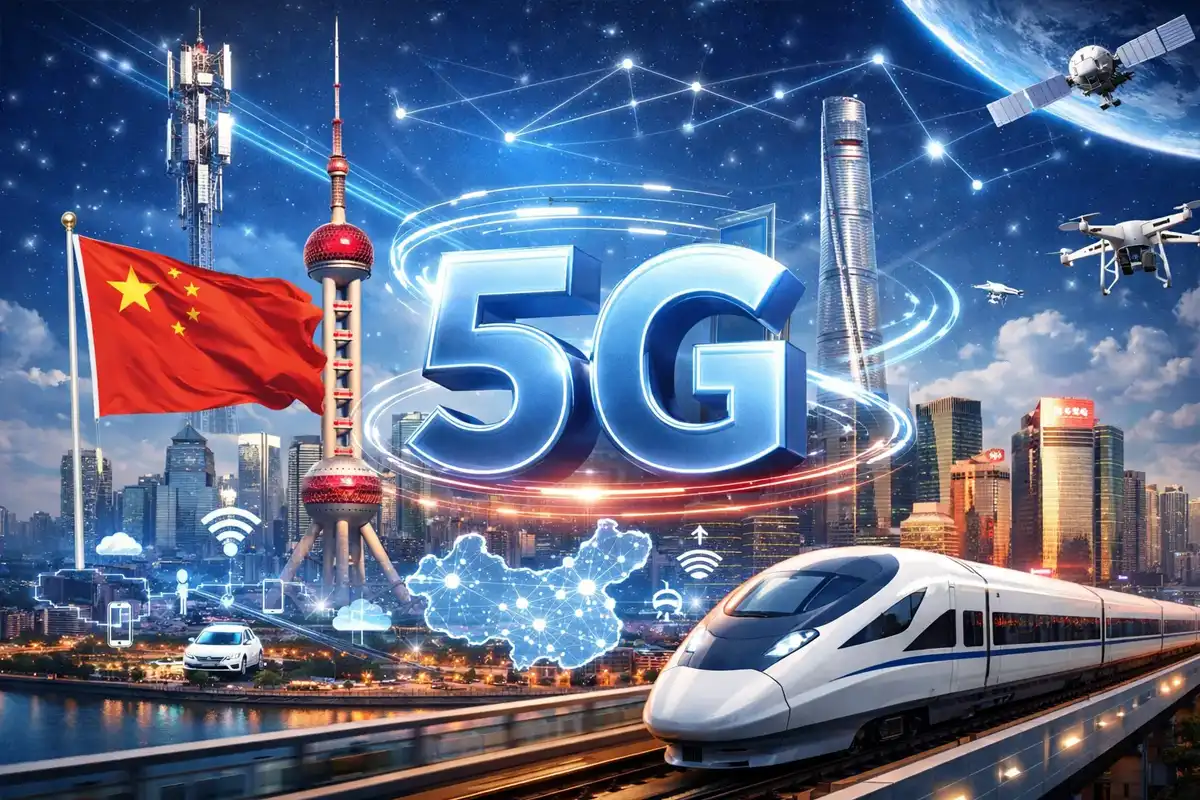
China Has Already Won the 5G Race. The 6G Race Has Begun — and America Is Starting Late Again.
The gap between Chinese and American wireless infrastructure is not a technology problem. It is a policy and investment problem. And it is getting wider, not narrower.
The numbers that define China’s 5G advantage are not close. China has deployed more than 4.8 million 5G base stations. The United States has between 300,000 and 500,000. China installs five towers per ten square miles. America manages 0.4. The coverage density ratio is not a marginal disadvantage — it is a tenfold gap that translates directly into what each economy can and cannot do with the technology.
This is not a smartphone speed competition. It is a competition for the infrastructure layer that runs AI-enabled manufacturing, autonomous logistics, remote surgery, and military communications. Whoever owns that layer owns the economic architecture of the next two decades.
What Standalone 5G Actually Enables
The critical distinction in 5G deployment is between non-standalone networks — which use existing 4G infrastructure as a backbone — and standalone networks, which operate on independent 5G architecture and deliver the full capability the technology promises.
China has achieved 80 percent standalone 5G utilization. The United States sits at 30 percent. This gap matters because standalone 5G is the prerequisite for the applications that generate real economic transformation: latency low enough for robotic surgical systems operated across continents, private industrial networks running fully automated factories, smart port logistics where containers move without human direction, and AI inference at the network edge rather than in centralized data centers.
China has established more than 100,000 private industrial 5G networks. Smart ports in Shanghai and Tianjin operate with minimal human labor. Factories in Shenzhen run AI-directed production lines that reconfigure in real time. A surgeon in Beijing performed a documented remote procedure on a patient in a different province — a demonstration that required 5G’s sub-millisecond latency and would have been impossible on 4G infrastructure.
The 6G Problem America Has Not Solved Yet
China has not waited for America to close the 5G gap before moving to the next generation. In May 2026, China began 6G trials in the 6GHz band. Chinese entities — led by Huawei and ZTE — hold approximately 40 percent of global 6G patents. Both companies have entered second-phase trials.
China’s target for commercial 6G deployment is 2030. The United States remains in planning and standardization discussions. If the 5G trajectory repeats in 6G — and the patent concentration and trial timeline suggest it will — America will enter the 6G era already behind on infrastructure, behind on intellectual property, and behind on industrial application.
Why This Gap Is Strategic, Not Just Commercial
Military communications, autonomous weapons systems, battlefield AI, and satellite-ground integration all depend on the same wireless infrastructure layer that civilian 5G represents. A country with tenfold the base station density has tenfold the redundancy, coverage, and capacity for both commercial and military applications.
China built the infrastructure first. It is now writing the standards. The country that writes 6G standards shapes what every other nation’s network can and cannot do for the following decade.
America is not losing this race. It has not yet seriously entered it.
Disclaimer; Based on publicly available telecommunications deployment data and patent registry analysis
Catch all the World News, Breaking News Event and Trending News Updates on GTV News
Join Our Whatsapp Channel GTV Whatsapp Official Channel to get the Daily News Update & Follow us on Google News.
Must Read