
Poll: Only One in Three Americans Support the Iran War, Most Unclear About Trump’s Goals

Poll: Only One in Three Americans Support the Iran War, Most Unclear About Trump's Goals
Only one in three Americans now support the war on Iran, marking the lowest level of public support recorded in a Reuters/Ipsos poll since the conflict began five months ago. The latest survey also found that most Americans believe President Donald Trump has failed to clearly explain the goals of the US military involvement in Iran.
The poll was conducted from Friday to Sunday and showed that Trump’s approval rating increased slightly to 37%, three points higher than last month. His approval rating had previously reached the lowest level of his presidency.
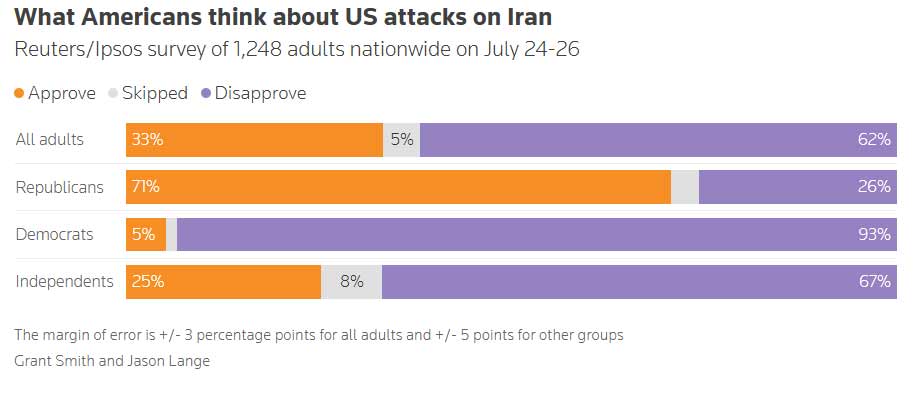
Trump has given several reasons for the US involvement in the conflict. These include helping Iranians remove their leaders, destroying Iran’s ballistic-missile capabilities and stopping the country from developing a nuclear weapon. However, 69% of Americans, including four in 10 Republicans, said Trump has not “clearly explained the goals of US military involvement in Iran.”
White House spokeswoman Olivia Wales said the president would not make decisions based on “fluid opinion polls.” She also repeated Trump’s position that Iran must be prevented from ever acquiring a nuclear weapon.
“What matters most to the American people is having a commander in chief who takes bold action to keep them safe,” Wales said.
Public support for the conflict has remained below 40% since the US and Israel launched strikes on February 28. This is a major difference compared with the early stages of other recent US wars.
The Iraq War, which lasted from 2003 to 2011, had the support of about 70% of Americans during its early months. In the early days of the Afghanistan War, which continued from 2001 to 2021, around 90% of Americans supported the conflict, according to Gallup polling.
Growing Public Concerns
The lack of public support for the war could create political problems for Trump and the Republican Party ahead of the November midterm elections. Trump’s allies are expected to defend their slim majorities in Congress.
Some Republican voters have also expressed doubts about the reasons behind the conflict.
Alex Womack, a retired turbine repair specialist from Stockbridge, Georgia, said he was unsure why the US had entered the war.
“It’s not clear why we started a war with them. I have no idea,” Womack said.
Womack, who served in the US Marine Corps during the Gulf War in 1991, said his support for Trump had declined because of the conflict.
“I don’t think he’s doing very well, personally,” he said.
The conflict has also resulted in casualties. So far, 18 American soldiers have died, while thousands of people have been killed in Iran and Lebanon, where Iran-allied fighters have fought Israeli forces.
Rising Gas Prices Add to Pressure
The war has also caused gasoline prices to rise sharply, putting additional pressure on American households. Gasoline prices are now averaging slightly above $4 a gallon nationwide, compared with around $3 a gallon before the war began on February 28.
Alex Conant, a Republican political strategist and former White House spokesman during George W. Bush’s presidency, said the conflict could create several political challenges for the Republican Party.
“This puts pressure on the party in a myriad of ways, all of them bad,” Conant said.
He added that the White House had been saying since January that the administration needed to focus on economic issues.
“The White House officials have been saying since January that they need to win economic arguments. It’s hard to win the economic arguments when you’re clearly focused on foreign policy,” Conant said.
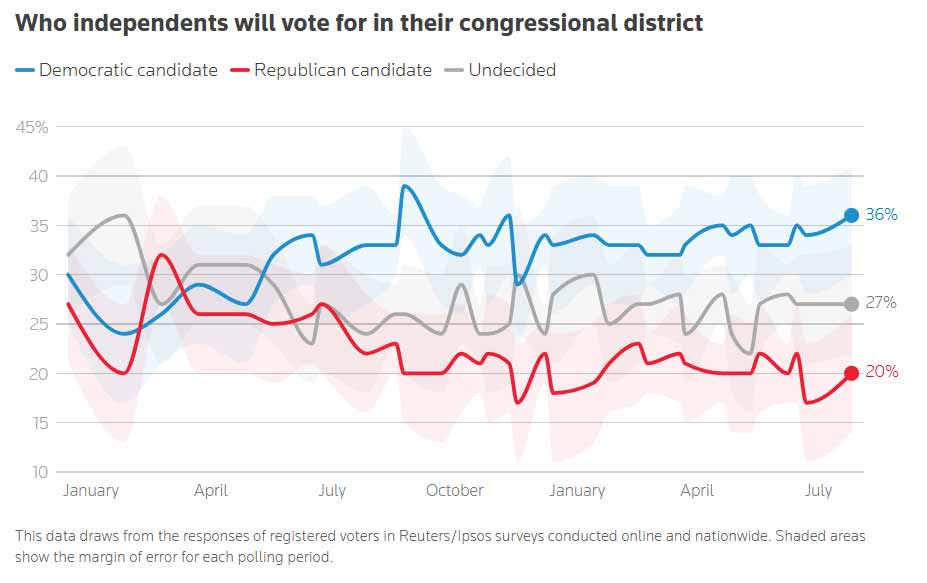
The latest Reuters/Ipsos poll also showed that independent voters were leaning toward Democratic congressional candidates. Among independent registered voters, 36% said they favored Democratic candidates, compared with 20% who preferred Republicans.
Independent voters also showed greater support for Democrats on economic policy, according to the poll.
Trump Had Promised to Avoid Long Wars
During his 2024 presidential campaign, Trump promised that he would keep the United States out of long-term conflicts. He initially estimated that the war with Iran would last four to five weeks.
Trump has also rejected comparisons between the Iran conflict and previous long wars, including the Vietnam War, which lasted around two decades and resulted in the deaths of more than 58,000 US soldiers.
Rhyan Anderson, an independent voter from Fairburn, Georgia, who voted for Trump in 2024, said he believes the president should focus more on problems inside the United States instead of helping Israel or other allies.
“My biggest thing is just focus on the people who are actually in the country,” said Anderson, who works two jobs in security and data collection and voted for Democrat Joe Biden in 2020.
“I know we have allies and things like that, but there’s a lot of people here that really need help,” he added.
Since mid-March, Reuters/Ipsos surveys have asked Americans whether they support or oppose military strikes on Iran. At that time, 37% of respondents said they supported the war.
That figure was higher than the 27% approval recorded on the day the war began. In that earlier survey, respondents were also allowed to select “unsure,” with 29% choosing that option.
The latest Reuters/Ipsos poll was conducted online across the United States and included 1,246 adults. The survey has a margin of error of plus or minus 3 percentage points.
Catch all the World News, Breaking News Event and Trending News Updates on GTV News
Join Our Whatsapp Channel GTV Whatsapp Official Channel to get the Daily News Update & Follow us on Google News.
Must Read