From Partition to Statehood: Pakistan’s Independence and the Question of National Identity

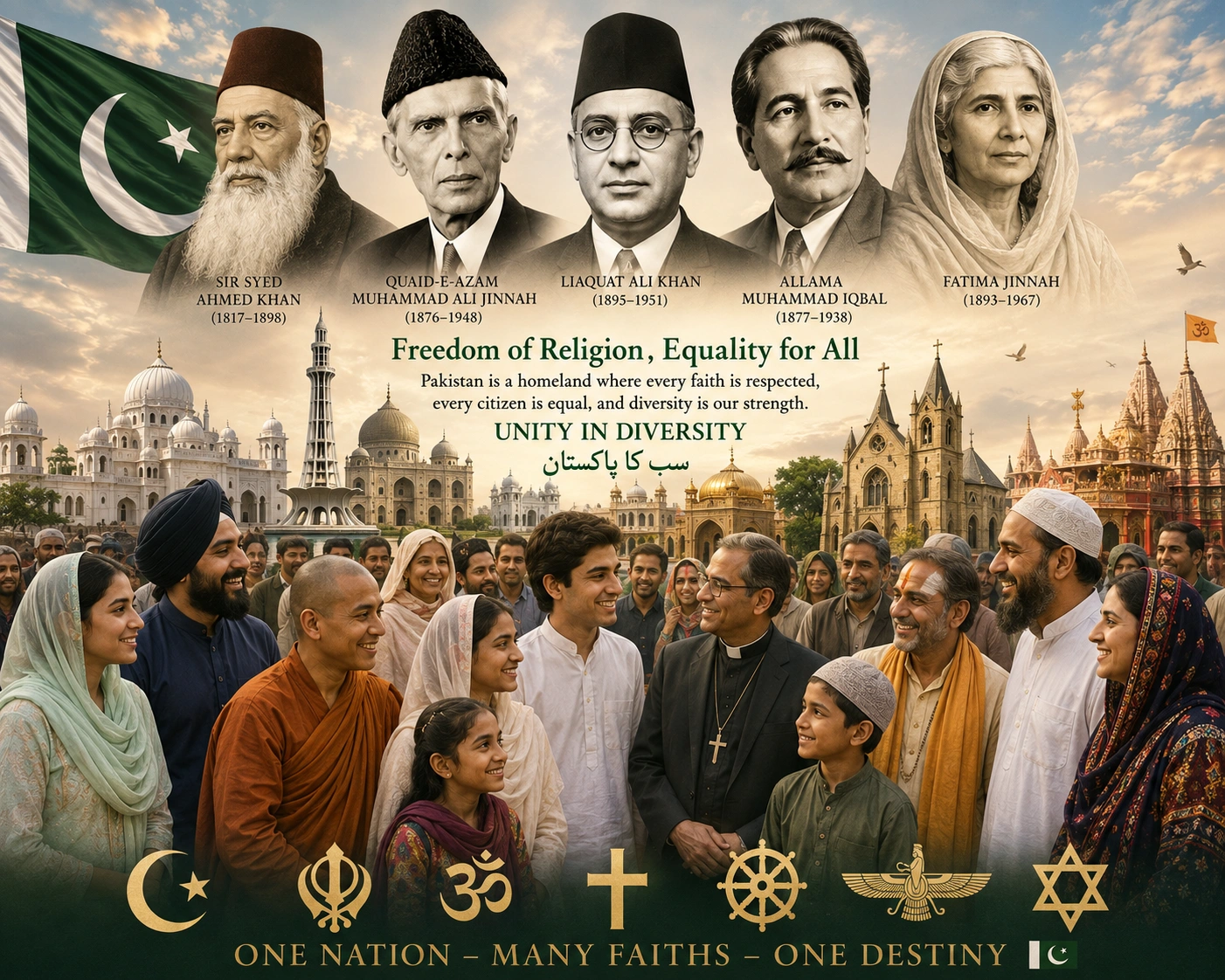
The creation of Pakistan in 1947 should be examined not simply as the culmination of a nationalist movement but as a complex process involving political representation, constitutional negotiation, collective identity, colonial state structures and the principle of self-determination. The demand emerged gradually within the political conditions of British India and cannot be adequately explained through a single event or personality. Its intellectual foundations developed through the educational reform associated with Sir Syed Ahmad Khan, its philosophical dimensions were articulated most prominently by many including Iqbal, its constitutional and political strategy was developed under Muhammad Ali Jinnah, and its transition from political demand to state-building involved figures such as Liaquat Ali Khan. At the regional level, leaders from Bengal, Sindh, Punjab and the North-West Frontier also contributed to the movement, demonstrating that the Pakistan demand was neither geographically uniform nor intellectually monolithic and the movement within the boundaries of Sub-Continent were organized be great many literate voices.
The nineteenth-century background is essential to understanding this evolution. The decline of Muslim political authority following the consolidation of British rule, particularly after the events of 1857, produced a crisis of political status, education and economic opportunity among sections of India’s Muslim population. Sir Syed Ahmad Khan responded primarily through educational and intellectual reform rather than immediate separatist politics. His Aligarh movement sought to equip Muslims with modern education and political understanding, while his writings increasingly addressed the implications of representative institutions in a religiously and culturally plural society. Sir Syed did not formulate the Pakistan demand as it later appeared, and it would be historically inaccurate to portray him as the founder of Pakistan in a literal sense. His importance lies instead in helping establish an intellectual environment in which questions of Muslim political identity, representation and institutional security could be discussed in modern political terms.
The formation of the All-India Muslim League at Dhaka in 1906 marked a further institutionalization of Muslim political representation. Bengal was particularly significant because of its demographic composition and its distinctive political development. Nawab Salimullah Khan, A.K. Fazlul Huq and later Huseyn Shaheed Suhrawardy represented important strands of Bengali Muslim politics. Fazlul Huq’s presentation of the Lahore Resolution in 1940 was especially consequential. The resolution proposed that Muslim-majority regions in the north-western and eastern zones of British India should be constituted into independent political units, with autonomous constituent units. Its original language was not identical to the centralized nation-state that Pakistan eventually became, a distinction important to any serious historical analysis. Nevertheless, Lahore transformed Muslim political demands from a question of constitutional safeguards into a more expansive debate about territorial and political sovereignty.
The role of Sindh similarly complicates any interpretation of Pakistan as a movement confined to northern India. G.M. Syed, one of the most prominent Sindhi political figures of the period, supported the Muslim League and was associated with the political process through which the Sindh Legislative Assembly became the first provincial legislature to pass a resolution supporting the Pakistan demand in 1943. His subsequent political transformation and eventual advocacy of Sindhi nationalism are historically significant, but they should not be projected backward to erase his earlier support for Pakistan. The trajectory of G.M. Syed illustrates that political identities are historically contingent: an individual may support the creation of a state at one stage and later criticize its institutional structure, constitutional direction or centre-province relationship.
Iqbal’s contribution was principally intellectual rather than organizational. His Allahabad Address of 1930 argued for the consolidation of Muslim-majority areas in north-western India within a political arrangement that would enable Muslims to develop their collective social and cultural life. His broader philosophical project, particularly the concept of Khudi, emphasized selfhood, agency and the capacity of individuals and communities to determine their historical development. Iqbal therefore provided a conceptual vocabulary through which Muslim political aspirations could be interpreted as more than demands for administrative privilege. His thought connected political autonomy with cultural development and collective agency, although the precise relationship between Iqbal’s proposal and the territorial state created in 1947 remains a subject of historical interpretation.
The political transformation of the Muslim League was inseparable from Jinnah’s constitutional strategy. Jinnah’s earlier political career is significant because he initially advocated constitutional cooperation and was associated with efforts toward Hindu-Muslim political accommodation. His later support for partition therefore represented a political evolution rather than an unchanging position. The constitutional reforms of the colonial period, separate electorates, disagreements over representation, the experience of the Congress ministries after the 1937 provincial elections, and competing conceptions of federal power contributed to an increasingly polarized political environment. From the Muslim League’s perspective, the central problem was not merely religious difference but the possibility that a majoritarian democratic structure could produce permanent political disadvantage for Muslims in an undivided India.
This raises the central theoretical issue underlying the Pakistan movement, whether numerical democracy alone is sufficient to guarantee political equality in a deeply plural society. The Muslim League increasingly argued that constitutional safeguards could not adequately protect a community that constituted a demographic majority in some regions but a permanent minority at the all-India level. The alternative proposed by the movement was territorial self-determination for Muslim-majority regions. From this perspective, Pakistan can be interpreted through the broader twentieth-century language of national self-determination, although the application of the concept to religiously defined communities remains contested among historians and political theorists.
The movement also demonstrates the political function of ideology and slogans. Expressions such as “Pakistan ka matlab kya? La ilaha illallah” became powerful instruments of political mobilization, translating a complicated constitutional and political argument into an emotionally accessible statement. Academic analysis, however, requires a distinction between a movement’s mobilizing rhetoric and its constitutional program. A slogan is not necessarily a legal definition of the state. Political movements routinely employ symbols that condense complex aspirations into memorable language; the same phenomenon can be observed in nationalist movements built around concepts such as liberty, equality, revolution or national destiny. In Pakistan’s case, the slogan expressed the religious and cultural aspirations of many supporters, but the institutional conception of the new state must be examined through the Lahore Resolution, Jinnah’s constitutional arguments and speeches, the Constituent Assembly debates, the Objectives Resolution and subsequent constitutional development rather than through a single popular phrase. The distinction is analytically important ideology can mobilize a population, but institutions determine the actual character of a state.
The decisive political phase came with the 1945–46 elections, in which the Muslim League secured overwhelming support in Muslim-reserved constituencies and strengthened its claim to represent Muslim political interests. The failure of the Cabinet Mission Plan of 1946 to establish a durable constitutional compromise, followed by escalating political conflict and communal violence, narrowed the possibilities for a united constitutional settlement. The British decision to transfer power, formalized through the 3 June Plan, ultimately resulted in partition. Pakistan emerged on 14 August 1947, while India became independent on 15 August. Partition transformed a constitutional dispute into a territorial division accompanied by one of the largest forced migrations of the twentieth century.
The creation of Pakistan therefore cannot be separated from the human consequences of partition. Millions of people crossed newly established borders, while communal violence produced extensive deaths, displacement and destruction of property. A scholarly interpretation should resist both extremes: portraying partition exclusively as either an uncomplicated triumph of nationalism or an entirely artificial colonial conspiracy both view point have been intensely debated. Political demands had developed among Indian actors over decades, but they operated within a colonial constitutional structure and were profoundly affected by British policies, institutional arrangements, wartime developments and the accelerated timetable of withdrawal. The outcome was consequently produced by the interaction of Indian political agency and British imperial circumstances, rather than by either factor alone.
The question of British influence continues into the post-1947 debate. Some scholars characterize Pakistan’s early political order as heavily shaped by the colonial state because the new country inherited the bureaucracy, military organization, police structures, legal codes and administrative institutions of British India. Contemporary scholarship continues to examine how this institutional inheritance affected centralization, civil-military relations, provincial administration and the development of democratic politics. This interpretation does not necessarily mean that Pakistan itself was still a British colony after independence. Legally, Pakistan became an independent Dominion on 14 August 1947, and its provisional constitutional order was based on the adapted Government of India Act 1935 under the India Independence Act 1947. The Constituent Assembly possessed the authority to legislate and to frame a constitution. Thus, describing post-1947 Pakistan simply as a British colony is constitutionally imprecise, while arguing that it retained substantial colonial institutional structures and practices is a legitimate subject of scholarly inquiry. The distinction between sovereignty and decolonization is crucial political independence can occur at a particular moment, while the transformation of inherited institutions may take decades which now in recent times seem very much possible.
Liaquat Ali Khan consequently belonged to the second phase of the Pakistan project: the transformation of political independence into a functioning constitutional state. As the first Prime Minister, he faced the immediate problems of refugee rehabilitation, institutional consolidation, economic disruption, territorial disputes and constitutional construction. The Objectives Resolution of 1949 became an important stage in defining the principles around which Pakistan’s constitutional order would develop. Its significance is best understood not as a simple continuation of the movement’s slogans but as part of the difficult process through which the founding aspirations of the Pakistan movement were translated into constitutional principles and state institutions.
The historical significance of Pakistan’s creation therefore lies in the interaction of ideas, institutions and political circumstances. Sir Syed contributed to the intellectual modernization and political consciousness of Indian Muslims; Iqbal supplied a philosophical vocabulary of collective selfhood and political autonomy; Jinnah transformed Muslim political demands into a disciplined constitutional movement; Liaquat participated in the institutional construction of the new state; Fazlul Huq and other Bengali leaders demonstrated the importance of eastern Muslim-majority politics; and G.M. Syed illustrated both the early provincial support for Pakistan and the subsequent complexity of regional political identities. None of these figures can be reduced to a single slogan or a simplified heroic narrative.
The creation of Pakistan is consequently best understood neither as an inevitable historical destiny nor as an event entirely manufactured by colonial policy. It was the outcome of political choices made by Indian leaders within a rapidly changing imperial and constitutional environment. Its intellectual foundations lay in debates over identity, representation, community and political autonomy; its immediate causes were rooted in constitutional failure, electoral politics, competing nationalisms and the breakdown of power-sharing; and its final form was shaped by the circumstances under which British rule ended.
The enduring philosophical question is therefore not merely why Pakistan was created, but what the creation of Pakistan tells us about the relationship between collective identity and citizenship, majority rule and minority protection, sovereignty and institutional inheritance, and political ideals and constitutional reality. The answer remains contested and precisely for that reason, the creation of Pakistan continues to be a subject worthy of historical and political inquiry rather than merely celebration or condemnation, we as a Nation still should praise the roles of leaders to provide us a foundation of dialogue and Identity.
Catch all the Blogs News, Breaking News Event and Trending News Updates on GTV News
Join Our Whatsapp Channel GTV Whatsapp Official Channel to get the Daily News Update & Follow us on Google News.
Must Read