
The Woman Who Refused to Stop Thinking

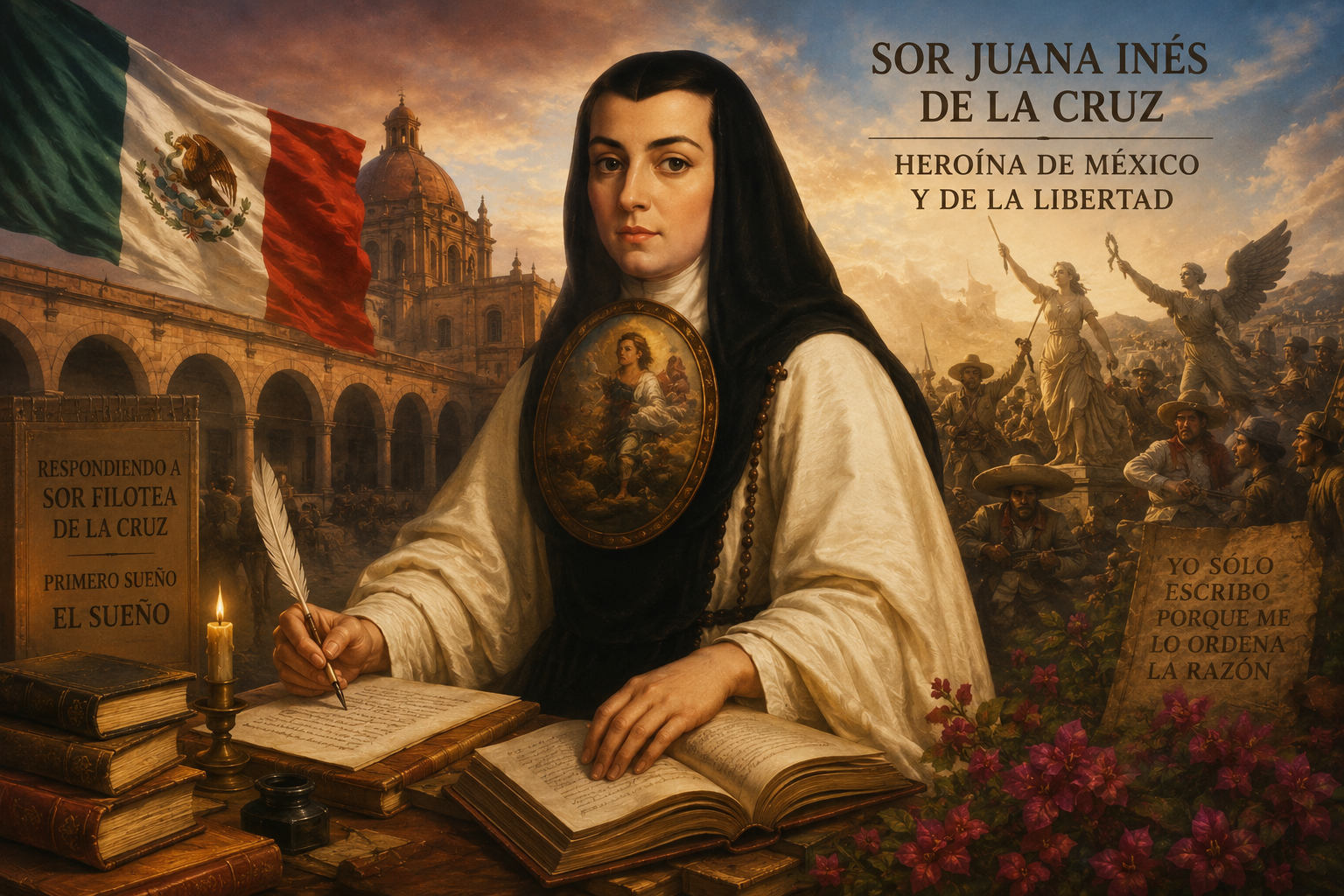
History often remembers conquerors, kings, and revolutionaries, yet some of its most profound revolutions were fought not with armies but with ideas. Few lives illustrate this truth more powerfully than that of Sor Juana Ines de la Cruz, a seventeenth-century Mexican nun whose greatest weapon was her intellect. Living in colonial New Spain at a time when women were expected to remain silent, obedient, and intellectually invisible, Sor Juana transformed the simple act of learning into a form of resistance. She never led a political uprising, drafted a constitution, or commanded an army, yet her relentless pursuit of knowledge challenged the foundations of colonial authority, religious dogmatism, and patriarchal society. More than three centuries after her death, she remains one of Latin America’s greatest philosophers, poets, feminists, and defenders of intellectual freedom.
Born as Juana Ramírez de Asbaje in San Miguel Nepantla in the mid-seventeenth century, Sor Juana entered a world that offered few opportunities to women beyond marriage or religious life. Yet even as a child, she refused to accept the limits that society imposed upon her. According to her own recollections, she secretly followed her older sister to school, learned to read before most children could write, and devoured every book she could find in her grandfather’s library. She famously pleaded with her mother to disguise her as a boy so she could attend the Royal University of Mexico because she understood, even as a little girl, that knowledge was the key to freedom. Her request was denied, but the rejection only deepened her determination to educate herself. While others saw learning as a privilege reserved for men, Sor Juana regarded it as a divine calling that no earthly authority had the right to deny.
Her extraordinary intelligence soon became impossible to ignore. As a teenager she was summoned to the viceregal court, where nearly forty scholars examined her on theology, philosophy, literature, history, mathematics, astronomy, and classical languages. The examination was intended to test whether the stories of her brilliance were exaggerated. Instead, it became one of the most celebrated intellectual triumphs in colonial history. She answered every challenge with remarkable confidence, leaving seasoned scholars astonished that such mastery belonged to a young woman who had been largely self-taught. In a society where women were rarely permitted to demonstrate intellectual authority, Sor Juana quietly dismantled centuries of prejudice simply by proving what she could do.
Yet admiration did not translate into freedom. The expectations of court life inevitably pointed toward marriage, a future Sor Juana believed would imprison the mind she had spent her entire childhood cultivating. She openly admitted having a “total disinclination to marriage” because she wished “to have no fixed occupation which might curtail my freedom to study.” Her decision to enter the Convent of San Jeronimo was therefore not an escape from the world but a calculated pursuit of intellectual independence. Within the convent walls she built what was perhaps the greatest private library in colonial America, collecting thousands of books alongside scientific instruments, globes, musical devices, maps, and works of art. The convent became her university, her laboratory, and her literary academy. It was there that she produced poetry, philosophical essays, religious dramas, comedies, scientific reflections, and theological critiques that secured her place among the greatest writers of the Spanish Baroque.
What distinguished Sor Juana from many of her contemporaries was not merely her vast learning but the philosophical vision that united it. She believed that knowledge was the highest expression of humanity because the capacity to reason reflected the image of the Creator. For her, science and faith were never enemies. Astronomy revealed the order of creation, music expressed mathematical harmony, literature illuminated human nature, and philosophy cultivated moral wisdom. Every branch of learning ultimately pointed toward divine truth. In an era often portrayed as hostile to scientific inquiry, Sor Juana insisted that studying the natural world was itself an act of devotion. The universe, she believed, was God’s greatest book, and every curious mind had both the right and the responsibility to read it.
Perhaps no sentence better captures her philosophy than her famous observation that “one can perfectly well philosophize while cooking supper.” On the surface, the remark appears playful, almost domestic. In reality, it is one of the most radical philosophical statements of the seventeenth century. Sor Juana rejected the idea that wisdom belonged exclusively to universities, monasteries, or learned men. She argued instead that philosophy begins wherever thoughtful observation begins. A kitchen could become as profound as a classroom because reason accompanies the human mind wherever it goes. In a single sentence she overturned centuries of intellectual elitism, insisting that women engaged in everyday life possessed the same capacity for reflection as any celebrated scholar.
Her greatest philosophical achievement, Primero Sueno (First Dream), transformed poetry into a meditation on the human condition. Unlike traditional religious poems that celebrate certainty, First Dream explores uncertainty. As the body sleeps, the soul embarks upon a magnificent journey to understand the universe, ascending through layers of knowledge in search of absolute truth. Yet as dawn approaches, the soul discovers that complete understanding remains forever beyond human reach. Rather than treating this realization as defeat, Sor Juana celebrates the journey itself. The search for truth becomes more important than possessing it. Human greatness lies not in omniscience but in the courage to keep asking questions despite knowing that every answer will reveal another mystery. In this sense, her philosophy anticipated later thinkers who viewed inquiry itself as the essence of intellectual life.
Her commitment to reason found its most powerful expression in Respuesta a Sor Filotea de la Cruz, a letter that has since become one of the foundational texts of feminist thought in the Americas. When church authorities criticized her for studying secular subjects and suggested that intellectual pursuits were inappropriate for women, Sor Juana responded not with anger but with extraordinary logic. Drawing upon scripture, theology, classical philosophy, and history, she demonstrated that women had always contributed to learning whenever society permitted them to do so. She argued that preventing women from studying was not merely unfair but irrational because God had bestowed reason upon both men and women alike. If reason is a divine gift, she insisted, then cultivating that gift cannot be sinful. Her argument remains astonishingly modern because it appeals not to emotion but to universal principles of justice and consistency.
This defense of women’s education established Sor Juana as one of history’s earliest feminist philosophers. She did not demand superiority over men, nor did she reject religion or tradition altogether. Instead, she challenged the contradictions embedded within patriarchal society. Her celebrated poem Hombres Necios (“Foolish Men”) remains one of the sharpest critiques of gender hypocrisy ever written. Through biting irony, she exposed how men encouraged behavior in women only to condemn them for it afterward, creating impossible standards that guaranteed female blame regardless of circumstance. Her criticism was directed not at men as individuals but at systems of injustice that rewarded contradiction while punishing women for the consequences. It was an argument grounded in ethics, logic, and moral consistency rather than ideological confrontation.
Although Sor Juana lived more than a century before Mexico’s War of Independence, her influence upon the country’s intellectual development cannot be separated from its later political awakening. She demonstrated that New Spain possessed its own cultural and philosophical voice, capable of producing original scholarship rather than merely imitating Europe. By weaving together Indigenous traditions, Nahuatl language, Christian theology, classical philosophy, and Spanish literary forms, she created a uniquely Mexican intellectual identity. In works such as El Divino Narciso, she acknowledged the complexity of Mexico’s colonial experience while affirming the richness of its blended cultural heritage. Long before political independence became imaginable, Sor Juana had already achieved something equally significant: intellectual independence.
Her social philosophy extended naturally from these ideas. She believed education was society’s greatest instrument of justice because ignorance perpetuated inequality while knowledge expanded human dignity. She argued that educating women strengthened families, enriched communities, and elevated civilization itself. Merit, she believed, should define human worth rather than birth, gender, or inherited privilege. These convictions anticipated later democratic ideals, suggesting that societies flourish when they value talent and reason above social hierarchy. In many respects, Sor Juana’s worldview foreshadowed principles that would only become politically widespread during the Enlightenment and the democratic revolutions of the eighteenth century.
Yet history also reminds us that extraordinary brilliance often provokes extraordinary opposition. As Sor Juana’s fame grew, so too did the hostility of powerful religious authorities who viewed her intellectual independence with increasing suspicion. The publication of her private critique of a Jesuit sermon without her consent became the catalyst for a sustained campaign against her scholarship. Pressured by church officials, deprived of influential patrons, and increasingly isolated, she was ultimately compelled to surrender the treasures that had defined her intellectual life. Her magnificent library was sold, her scientific instruments and musical collection dispersed, and she abandoned the secular studies to which she had devoted her life. Whether this withdrawal reflected genuine spiritual transformation or resignation before overwhelming institutional power remains one of literary history’s enduring tragedies. What cannot be disputed is that one of humanity’s greatest minds was forced into silence.
Even in silence, however, Sor Juana continued to embody the ideals she had always defended. When plague swept through the convent in 1695, she devoted herself to caring for her fellow sisters despite the mortal danger. She eventually contracted the disease herself and died while serving others, ending a life marked equally by intellectual brilliance and profound compassion. The institutions that attempted to suppress her ideas have faded into history, yet her writings continue to inspire readers across continents and centuries.
Today Sor Juana Ines de la Cruz is celebrated as Mexico’s “Tenth Muse,” one of the greatest poets of the Spanish language, one of the first feminist philosophers of the Americas, and one of the earliest defenders of academic freedom. Her image appears on Mexican currency, universities preserve her memory, and her works remain central to discussions of philosophy, literature, gender, education, theology, and human rights. More importantly, her life continues to remind the modern world that knowledge is not merely information but liberation. Every book she read, every poem she wrote, every argument she defended challenged the belief that authority has the right to dictate who may think and who must remain silent.
Perhaps Sor Juana’s greatest lesson is that civilizations advance not simply through political revolutions but through intellectual ones. Empires rise and fall, governments change, and borders shift, but ideas possess a remarkable permanence. A single courageous thinker can alter the moral imagination of generations yet unborn. Sor Juana never sought power, wealth, or conquest. She sought understanding. In doing so, she transformed the pursuit of knowledge into one of history’s quietest yet most enduring revolutions, proving that the strongest force against ignorance has never been violence, but an educated mind unwilling to surrender its curiosity.
Catch all the Blogs News, Breaking News Event and Trending News Updates on GTV News
Join Our Whatsapp Channel GTV Whatsapp Official Channel to get the Daily News Update & Follow us on Google News.
Must Read