
Nusrat Fateh Ali Khan: The Eternal Voice of Qawwali, Sufi Philosophy and Musical Transformation

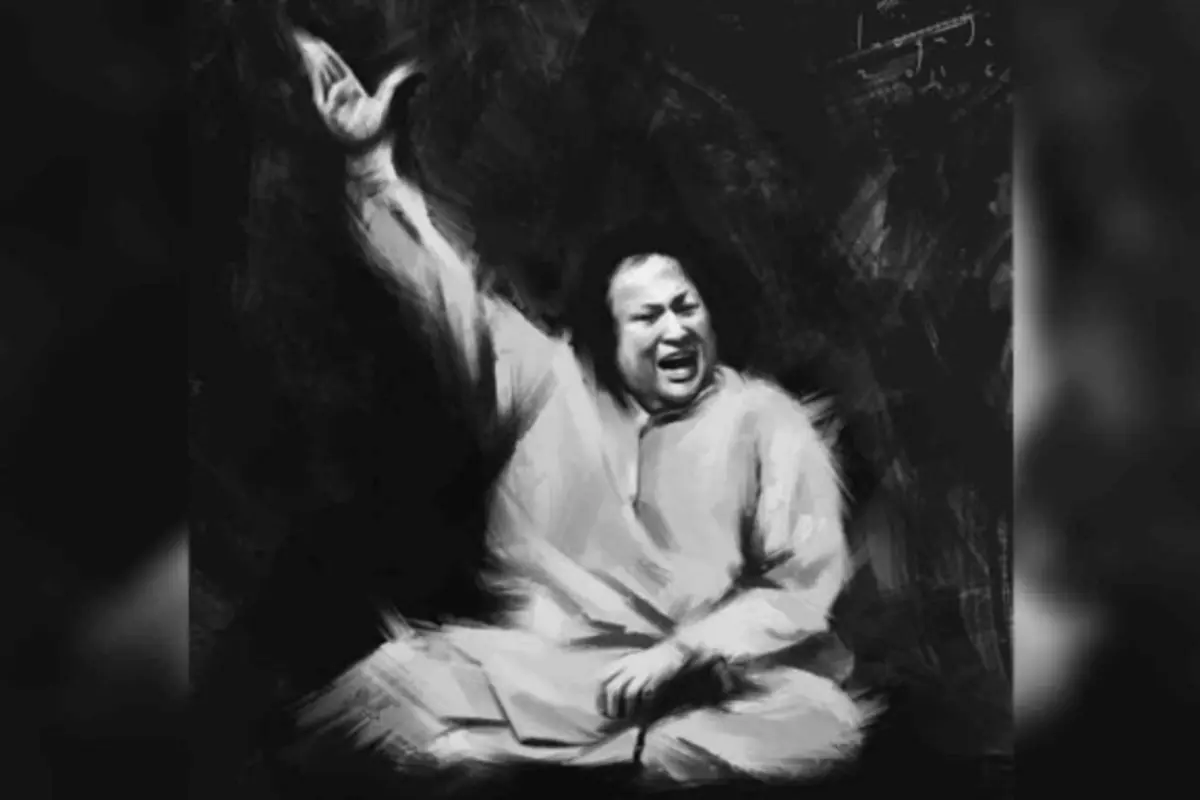
Nusrat’s greatness cannot be understood merely through his vocal range, technical mastery or international recognition. His significance lies in the philosophical depth of his music. Qawwali is not simply a genre of singing; it is an artistic expression of the Sufi understanding of love, longing, devotion and the search for a reality beyond the visible world. Rooted in the mystical traditions of the Indian subcontinent, qawwali brings together poetry, rhythm, repetition and collective participation to create an experience that can move beyond ordinary distinctions between performer and audience. Through his music, Nusrat gave this tradition a remarkable contemporary presence without severing its connection with its spiritual foundations.
His voice possessed a rare duality: it could express tenderness and anguish, restraint and intensity, human vulnerability and an almost overwhelming sense of transcendence. In compositions such as Allah Hoo, Dam Mast Qalandar, Mera Piya Ghar Aaya and Yeh Jo Halka Halka Suroor Hai, the voice became an instrument of philosophical inquiry. The listener encounters not only a melody but also the experience of longing: the desire to overcome separation, to discover meaning in suffering and to find unity within the apparent divisions of existence. Nusrat’s singing demonstrated that music could communicate emotional truths for which ordinary language often proves inadequate.
The classical foundation of his artistry was central to this achievement. Trained within a distinguished musical family, he inherited a demanding tradition of vocal discipline, melodic development and rhythmic precision. His performances drew upon the principles of South Asian classical music, including intricate ornamentation, improvisation, sustained melodic phrases and the gradual development of musical intensity. His mastery of raag, his command of breath and his ability to move between delicate passages and extraordinary vocal climaxes distinguished him from many of his contemporaries. Yet technical virtuosity never became an end in itself. It served the larger purpose of emotional and spiritual expression.
In Nusrat’s performances, the relationship between discipline and freedom was particularly compelling. Classical training supplied the structure, while improvisation allowed the music to become an unfolding event. A familiar melodic phrase could return repeatedly, yet each repetition carried a different emotional weight. Rhythm intensified, the accompanying chorus responded, and the audience gradually became part of the performance’s emotional architecture. This was not merely the reproduction of a composition but the creation of a shared experience in real time. His music demonstrated a profound artistic principle: tradition remains alive not through mechanical repetition but through the capacity to reinterpret inherited forms without losing their essential character.
The Sufi dimension of Nusrat’s music gives this artistic achievement its deepest philosophical significance. Sufi poetry frequently explores the relationship between the lover and the beloved, the finite and the infinite, the individual self and a greater spiritual reality. These expressions may speak of divine love, but they also engage universal human experiences of separation, devotion, loss and transformation. In this tradition, longing is not necessarily a weakness; it can become a path towards self-discovery. Love is not confined to possession, and suffering is not always meaningless. Through the intensity of his voice, Nusrat transformed these poetic ideas into an experience that listeners could feel even when they did not understand the language of the lyrics.
His performances also invite reflection through the concept of fana, a central idea in Sufi thought associated with the dissolution of the ego before the Divine. This should not be understood as a literal description of every musical performance, but as a useful philosophical lens through which to appreciate the self-transcending quality of qawwali. At the height of a performance, the singer appears to move beyond individual display, becoming absorbed in the music, the poetry and the devotional atmosphere. Nusrat’s extraordinary vocal improvisations could create precisely this impression: the artist was not simply demonstrating what his voice could accomplish but pursuing an emotional intensity that seemed to exceed the boundaries of the individual self.
His art also challenges the assumption that spirituality and modernity must remain in opposition. During the 1980s and 1990s, Nusrat collaborated with musicians from different musical backgrounds, including British musician Peter Gabriel and Canadian musician Michael Brook. His contributions to Gabriel’s Passion, associated with Martin Scorsese’s film The Last Temptation of Christ, and his work on Mustt Mustt and Night Song introduced his voice to audiences beyond the conventional qawwali circuit. These collaborations demonstrated that a traditional devotional form could enter new musical environments without necessarily surrendering its identity. Nusrat did not simply carry Pakistani music abroad; he challenged international audiences to reconsider the boundaries between devotional music, popular culture and artistic experimentation.
This international recognition also raises an important question about cultural exchange. Globalisation can sometimes turn distinctive cultural traditions into simplified commodities, detached from their historical and spiritual contexts. Yet it can also create opportunities for dialogue, discovery and mutual appreciation. Nusrat’s achievement lay in making qawwali accessible without reducing its emotional complexity to a purely exotic spectacle. His music crossed linguistic and geographical boundaries because its expressive force did not depend entirely on literal translation. The voice itself became a bridge between cultures, revealing how artistic experience can establish connections where words, nationality and inherited social identities might otherwise create distance.
Nusrat Fateh Ali Khan’s legacy is especially relevant today, as a new generation encounters qawwali through remixes, electronic arrangements, short-form videos, digital platforms and contemporary popular music. The emergence of this new genre of qawwali remixes reflects changing listening habits and the transformation of musical production in the digital age. Traditional melodies and devotional refrains are increasingly combined with electronic beats, amplified bass, synthesised sounds and modern rhythmic structures. For younger listeners, these reinterpretations may serve as an entry point into a musical tradition they might otherwise encounter less frequently. They can introduce classical vocal techniques and Sufi poetry to audiences whose musical experiences have been shaped by contemporary pop culture.
However, the growing popularity of qawwali remixes also raises an essential cultural and philosophical question: what happens when a devotional tradition is transformed into a product of entertainment? The answer requires a distinction between musical innovation and the loss of meaning. Musical traditions have never remained entirely static. They develop through changing instruments, performance settings, patronage systems and artistic encounters. Nusrat himself experimented with musical arrangements and international collaborations. It would therefore be historically simplistic to argue that every departure from traditional performance is a betrayal of qawwali.
Nevertheless, experimentation becomes problematic when the spiritual and poetic substance of the music disappears beneath its commercial presentation. Qawwali is not defined solely by a recognizable melody or a powerful refrain. Its deeper character emerges from the relationship between poetry, musical improvisation, collective participation and devotional intention. A remix may preserve the hook of a famous composition while removing the gradual melodic development, the interaction between the lead singer and chorus, or the poetic progression through which a qawwali builds its emotional force. In such cases, the music may retain its surface identity while losing some of the elements that give the tradition its distinctive depth.
The challenge, therefore, is not to reject remixes but to evaluate what they preserve, transform and communicate. A thoughtful contemporary adaptation can create new possibilities for cultural transmission. It can encourage a young listener to explore the original recording, learn about the poetry, understand the meaning of Sufi concepts and appreciate the discipline behind classical improvisation. Conversely, an arrangement designed exclusively for immediate consumption may detach the music from its cultural memory. The crucial question is not whether qawwali uses electronic instruments or modern production techniques, but whether the resulting work maintains a meaningful relationship with the tradition from which it draws.
Nusrat’s own career provides a useful framework for understanding this distinction. His experiments were built upon an exceptionally deep command of the tradition. He could reinterpret music because he understood its internal structures, emotional possibilities and spiritual associations. His innovations did not emerge from a superficial encounter with qawwali; they emerged from a lifetime of engagement with its vocabulary. This suggests an important principle for contemporary musicians: creative freedom becomes more meaningful when it is accompanied by historical awareness and technical understanding. Innovation need not imitate the past, but it should recognize the depth of what it transforms.
The digital age also changes the relationship between the artist and the audience. In a traditional qawwali gathering, musical intensity develops gradually through sustained listening, repetition and collective response. Digital platforms, by contrast, often reward brevity, immediate impact and repeated circulation of short musical fragments. A single vocal climax can become a viral clip, detached from the composition that gives it context. Although such circulation expands the reach of Nusrat’s voice, it can also reduce a complex performance to a moment of spectacle. The challenge for contemporary audiences is to move beyond the fragment and rediscover the complete musical experience.
There is, however, a hopeful side to this transformation. Young people are not necessarily indifferent to tradition; they often encounter it through different pathways. A remix may lead to an original recording, a popular refrain may inspire an interest in Urdu or Persian poetry, and a digital performance may introduce listeners to the philosophy of Sufism. Cultural inheritance does not always proceed directly from one generation to another. Sometimes it survives through reinterpretation, rediscovery and creative adaptation. If contemporary qawwali can inspire curiosity about its origins, then technological change may become an instrument of preservation rather than an agent of cultural disappearance.
Nusrat’s contribution also invites reflection on the future of Pakistani cultural identity. In a world where national cultures are frequently represented through political conflict, economic competition and narrow definitions of belonging, music offers another way of understanding a society. Nusrat carried the musical heritage of Pakistan into international spaces without requiring audiences to share his nationality, religion or language. His recognition demonstrated that cultural identity can be confidently expressed through openness rather than isolation. His music was rooted in a particular historical and spiritual landscape, yet it remained capable of generating emotional connections across cultural boundaries.
This is perhaps one of the most important lessons of his legacy. A culture does not become weaker simply because its artistic expressions travel beyond its borders. Nor does it become globally significant merely because its music is commercially successful. Its deeper influence depends on the ability to communicate something distinctive while remaining open to dialogue with others. Nusrat embodied this possibility. His music carried the memory of the subcontinent’s devotional traditions into the modern world, showing that cultural rootedness and international relevance can reinforce one another.
His enduring popularity also reveals the limitations of measuring artistic greatness through awards, commercial success or the number of recordings produced. Such achievements help document a career, but they cannot fully explain why a voice continues to move people decades after the artist’s death. Nusrat’s legacy survives because his performances address experiences that remain fundamental to human life: the desire to love, the pain of separation, the search for belonging, the confrontation with mortality and the hope that suffering may lead to a deeper understanding of existence. These themes do not belong to one nation or generation. They are part of the shared vocabulary of human experience.
On his birth anniversary, remembering Nusrat Fateh Ali Khan therefore means more than celebrating a musical genius. It means recognizing the extraordinary possibilities of an art form capable of joining technical excellence with spiritual inquiry, inherited tradition with creative freedom, and cultural particularity with universal expression. His classical mastery gave qawwali its musical architecture; his Sufi sensibility gave it philosophical depth; and his willingness to experiment helped it find new audiences around the world.
As contemporary musicians continue to reinterpret qawwali through remixes and digital technologies, Nusrat’s example offers both inspiration and responsibility. The future of the tradition need not be a choice between preservation and innovation. It can be a dialogue between them, provided that experimentation remains connected to the poetry, discipline and spiritual imagination that make qawwali more than a musical style.
Nusrat Fateh Ali Khan passed away in 1997, but his voice continues to occupy a space that time cannot easily diminish. It lives in the original recordings that preserve the intensity of his performances, in the musicians who study his technique, in the younger listeners discovering his music through new arrangements, and in the audiences who continue to experience the emotional power of his singing. His enduring significance lies not simply in the fact that he made qawwali famous, but in the way he demonstrated that music could transform inherited cultural memory into a living, evolving human experience.
Ultimately, Nusrat’s voice reminds us that music is at once an art, a cultural inheritance and a philosophical possibility. It can entertain without becoming superficial, innovate without abandoning its roots, and cross borders without erasing the identities from which it emerges. On his birth anniversary, the most meaningful tribute is not merely to reproduce his melodies or celebrate his fame, but to listen with the attention his art deserves: to the classical discipline beneath the improvisation, the Sufi longing within the poetry, and the human search for meaning that continues to make his voice unforgettable.
Catch all the Blogs News, Breaking News Event and Trending News Updates on GTV News
Join Our Whatsapp Channel GTV Whatsapp Official Channel to get the Daily News Update & Follow us on Google News.
Must Read

Pakistan
Bilawal Bhutto Calls KP Emergency Difficult but Necessary Constitutional Step
14-October،2026