
Federal Constitutional Court Reverses Orders Behind Nasla Tower Demolition in Karachi

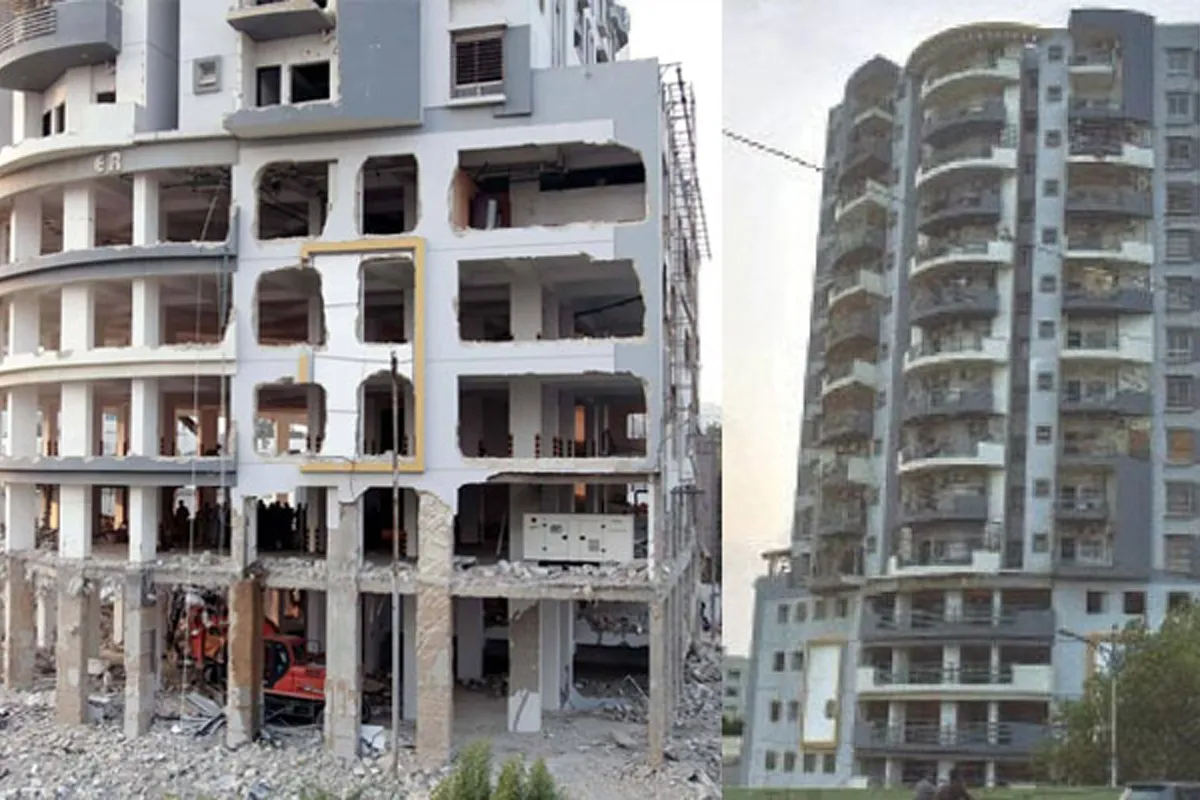
The Federal Constitutional Court (FCC) has recalled key Supreme Court orders issued in 2018 and 2019 that had paved the way for the demolition of several allegedly illegal structures in Karachi, including the 15-storey Nasla Tower located on Shahrah-e-Faisal.
In a landmark judgment, the FCC ruled that while the Supreme Court’s intention behind directing action against illegal constructions was aimed at improving the city’s development and planning, the enforcement of building regulations primarily falls within the responsibility of provincial authorities rather than the judiciary.
A two-member FCC bench, headed by Justice Aamer Farooq, delivered the ruling in appeals that were originally filed before the Supreme Court but were later transferred to the FCC following the 27th Constitutional Amendment.
The court observed that government departments and relevant authorities must ensure legal procedures are followed in each individual case. The FCC stated that demolition orders cannot be issued solely on the basis of reports from the Sindh Building Control Authority (SBCA) without ensuring due process and legal safeguards.
FCC Criticises Expansion of Supreme Court Proceedings
The judgment noted that the original proceedings before the Supreme Court were related to a specific construction dispute in Lyari’s Mussa Lane but later expanded into a wider campaign against alleged illegal constructions across Karachi.
The court observed that the Supreme Court proceedings gradually moved beyond the original issue and resulted in directions concerning numerous buildings and properties across the city.
The matter began after the Sindh High Court ordered the demolition of a multi-storey building in Mussa Lane in 2016. The building owner challenged the decision before the Supreme Court, where hearings continued from 2017 onwards.
During the proceedings, the Supreme Court sought details of buildings constructed without approved building plans and later directed authorities to take action against officials allegedly involved in facilitating unauthorised constructions.
In December 2018, the Supreme Court observed that illegal construction issues were not limited to Lyari but existed across Karachi. Subsequently, directions were issued to the SBCA and other authorities to address such violations.
Nasla Tower Demolition and Wider Anti-Encroachment Drive
The FCC noted that further Supreme Court orders in January 2019 expanded the scope of action, including directions regarding commercial activities and structures in areas such as Jam Sadiq Ali Park.
Following these orders, authorities launched extensive enforcement operations across Karachi, leading to action against various properties, including Nasla Tower, which was demolished several years later.
Several affected individuals and organisations, including the Association of Builders and Developers (ABAD), approached the Supreme Court between 2019 and 2025 seeking involvement in the proceedings.
After the establishment of the Federal Constitutional Court, these matters were transferred to the FCC for review.
The FCC stated that what initially started as a review of a specific court order eventually transformed into a broader judicial oversight mechanism over urban development issues.
The court described this expansion as a form of “continuous mandamus,” where the Supreme Court assumed a supervisory role beyond the original dispute.
Building Laws Remain Government Responsibility
The FCC stressed that courts must remain limited to issues directly connected with cases before them and should not initiate investigations or actions unrelated to the dispute being adjudicated.
At the same time, the judgment clarified that it does not provide legal protection to unauthorised constructions in Karachi. The court said existing laws and regulatory institutions already exist to deal with violations of building rules.
The ruling emphasised that the Sindh government and relevant departments have a constitutional and legal responsibility to regulate construction activities and ensure compliance with planning laws.
The FCC subsequently recalled the Supreme Court orders issued on December 21, 2018, and January 22, 2019, withdrawing related directions, reports, proceedings and pending actions connected to the matter.
Protection of Public Spaces and Citizens’ Rights
In an additional note, Justice Syed Arshad Hussain Shah highlighted the importance of protecting citizens’ fundamental rights, including access to public facilities and civic amenities.
The court noted that public spaces such as parks, playgrounds, green areas, libraries, community centres, footpaths, recreational areas, healthcare facilities and educational institutions are essential parts of citizens’ right to a dignified life.
The judgment stated that these public assets must be protected from illegal occupation, misuse or unauthorised conversion, and that no authority can reduce citizens’ rights related to approved public facilities except through constitutional and legal procedures.
The FCC ruling marks a significant development in the legal debate over judicial intervention, urban regulation and the balance between protecting public spaces and ensuring due process for citizens affected by government action.
Catch all the World News, Breaking News Event and Trending News Updates on GTV News
Join Our Whatsapp Channel GTV Whatsapp Official Channel to get the Daily News Update & Follow us on Google News.
Must Read


Pakistan
Sindh Government Allocates Rs5 Billion to Activate Karachi’s TP-1 Sewage Treatment Plant
3-October،2026