
Iran’s Full Control of Strait of Hormuz Establishes New Geopolitical Order in Middle East

TEHRAN: Iran has made it clear that the pre-war status quo in the strategically vital Strait of Hormuz will not be restored, with the country’s new strategy and military posture fundamentally changing the balance of power across the region.
The Strait of Hormuz has emerged as a major flashpoint in the Middle East, with Iran asserting greater control over one of the world’s most important maritime energy routes. Before the war, around 20 percent of global crude oil supplies passed through the waterway, making its security critical to international energy markets.
Iran’s position has now changed significantly. While Tehran previously faced extensive economic sanctions while foreign vessels continued to transit the waterway, Iran says that arrangement is no longer sustainable.
According to Iran’s military leadership, the Islamic Republic now exercises full and unchallenged control over the Strait of Hormuz. Iranian officials say hostile warships are being kept far from the country’s coastal waters and that opposing naval forces have been forced to maintain a considerable distance from the strategic passage.
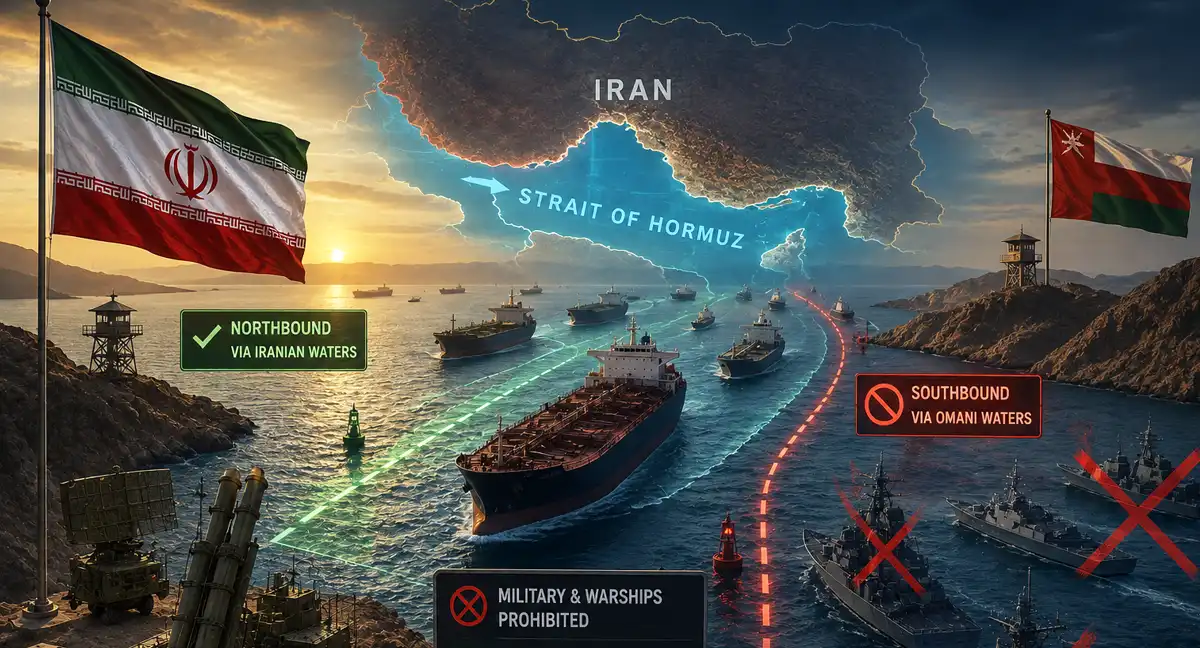
As part of the changing situation, Iran and Oman have developed a new transit framework for commercial shipping through the Strait of Hormuz.
Under the proposed arrangement, commercial vessels entering the Persian Gulf would use a northern route through Iranian territorial waters, while vessels leaving the Gulf would travel through Omani territorial waters.
The framework would restrict military and warship movements through the designated commercial routes, with only commercial vessels allowed to transit under Iranian permission and monitoring.
The developments have created a major strategic challenge for Washington, with reopening the Strait of Hormuz emerging as a key priority for the United States.
Iran has attached conditions to any future agreement concerning the waterway. Iranian officials have said that any sustainable understanding with Washington would require the practical removal of the economic blockade and pressure imposed on Iran.
Tehran maintains that the Strait of Hormuz can no longer operate under the same arrangements that existed before the conflict.
Iran’s new approach has wider implications for regional energy security and global trade.
With control over a critical maritime chokepoint, Tehran seeks to strengthen its influence over the movement of commercial vessels and energy supplies passing between the Persian Gulf and international markets.
Iranian officials argue that the country’s military posture and control over the waterway have fundamentally altered the strategic balance in the region.
The evolving situation around the Strait of Hormuz is therefore becoming more than a dispute over maritime traffic. It represents a broader struggle over regional security, energy routes and the balance of power between Iran, the United States and their respective partners.
Catch all the Blogs News, Breaking News Event and Trending News Updates on GTV News
Join Our Whatsapp Channel GTV Whatsapp Official Channel to get the Daily News Update & Follow us on Google News.
Must Read