

NASA’s Webb Telescope Detects Earliest Known Supernova 730 Million Years After Big Bang

Web Desk
10 December, 2025 12:04
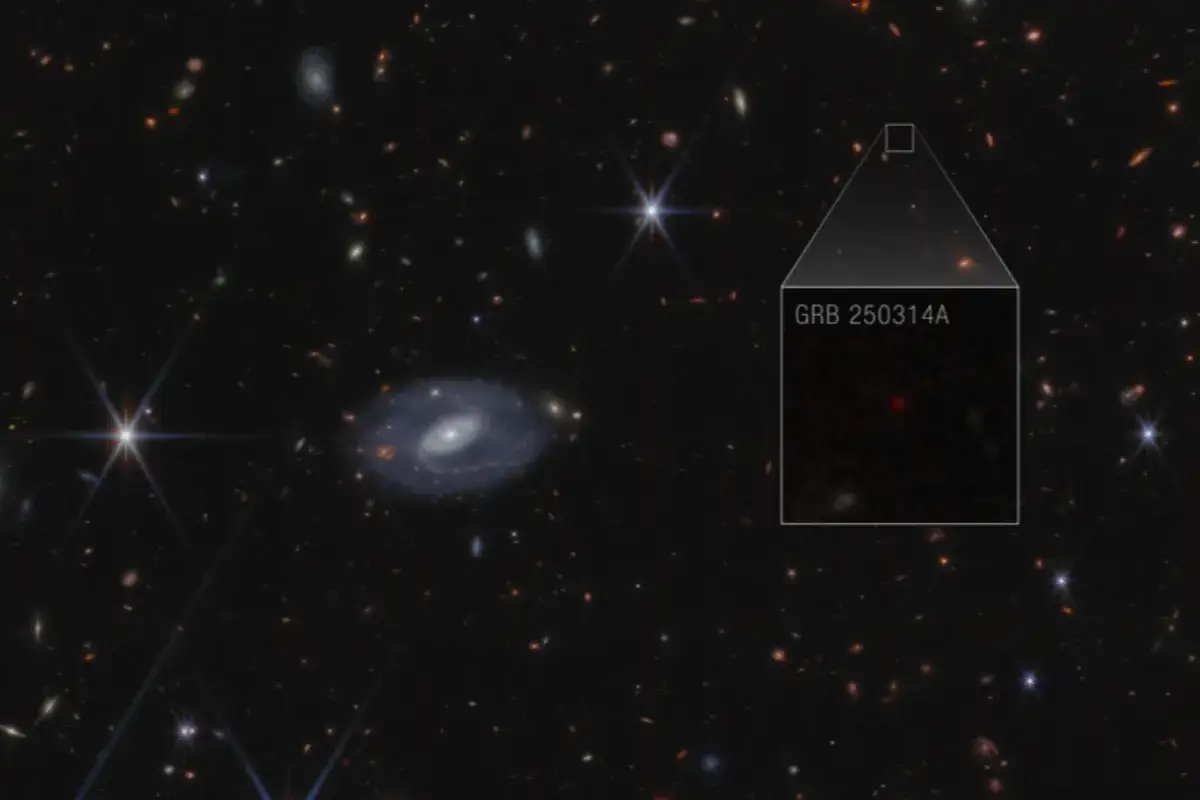
NASA’s Webb Telescope Detects Earliest Known Supernova 730 Million Years After Big Bang
NASA’s James Webb Space Telescope has identified the earliest known supernova, which exploded when the universe was approximately 730 million years old.
The supernova, designated GRB 250314A, was first detected as a gamma-ray burst in mid-March by the SVOM mission, a Franco-Chinese telescope designed to monitor transient astronomical events.
Following the initial detection, NASA’s Neil Gehrels Swift Observatory, the Nordic Optical Telescope, and the European Southern Observatory’s Very Large Telescope confirmed the distance and infrared afterglow of the event.
“Webb’s near-infrared observations, conducted on July 1, allowed astronomers to locate the faint host galaxy of the supernova, providing the earliest direct detection of such an event in the universe’s history.”
Tracing the Faint Host Galaxy of the Universe’s Earliest Supernova
Gamma-ray bursts are very strong, yet very short flashes of radiation, often associated with the death of massive stars in an explosive manner. In this case, the gamma-ray burst lasted 10 seconds, typical of long bursts linked to supernovae. Swift’s X-ray source localization took 90 minutes from the alert, while the Nordic Optical Telescope captured an infrared afterglow 11 hours later. The Very Large Telescope determined that the object formed 730 million years after the Big Bang.
Observations by Webb were conducted three and a half months after the gamma-ray burst, when the supernova was expected to reach its maximum brightness. NASA stated that Webb’s high-resolution near-infrared images “were able to resolve both the supernova and its faint host galaxy, thereby providing the earliest direct observation of a massive star undergoing a supernova collapse.”
Comparison with Nearby Supernovae
Researchers compared supernova GRB 250314A with modern, nearby supernovae. Despite occurring during the universe’s first billion years, the earliest supernova showed light and temporal characteristics consistent with those of contemporary supernovae. While early stars were likely more massive and contained fewer heavy elements, the observed supernova followed known supernova patterns.
The observations and analysis were conducted with contributions from Andrew Levan of Radboud University and the University of Warwick, Benjamin Schneider of the Laboratoire d’Astrophysique de Marseille, and Nial Tanvir of the University of Leicester, and reported in Astronomy and Astrophysics Letters. Webb’s data provide a direct view of stellar explosions during the early universe without relying on secondary models or simulations.
Observation of the Host Galaxy
Webb also captured the faint host galaxy of the supernova, appearing as a reddened cluster of pixels in near-infrared images. Emeric Le Floc’h of CEA Paris-Saclay reported that the galaxy exhibits characteristics similar to other galaxies from the same era. Studying the host galaxy allows researchers to understand the environments where early supernovae occurred.
Future Webb observations will aim to capture the afterglow of gamma-ray bursts in distant galaxies, offering further insight into early galaxies and their stellar populations. These observations were conducted under a Director’s Discretionary Time program approved for rapid response to transient events.
The James Webb Space Telescope, an international program led by NASA with partners from ESA and CSA, continues to provide crucial data on both nearby and distant galaxies. By identifying supernova GRB 250314A and its host galaxy, Webb has set a new record for the earliest observed supernova, supporting ongoing studies of the first stars and galaxies in the universe.
Catch all the Trending News, Breaking News Event and Trending News Updates on GTV News
Join Our Whatsapp Channel GTV Whatsapp Official Channel to get the Daily News Update & Follow us on Google News.
Must Read