

New Data Highlights Motion Anomalies in Interstellar Object 3I/ATLAS

Web Desk
29 December, 2025 11:51
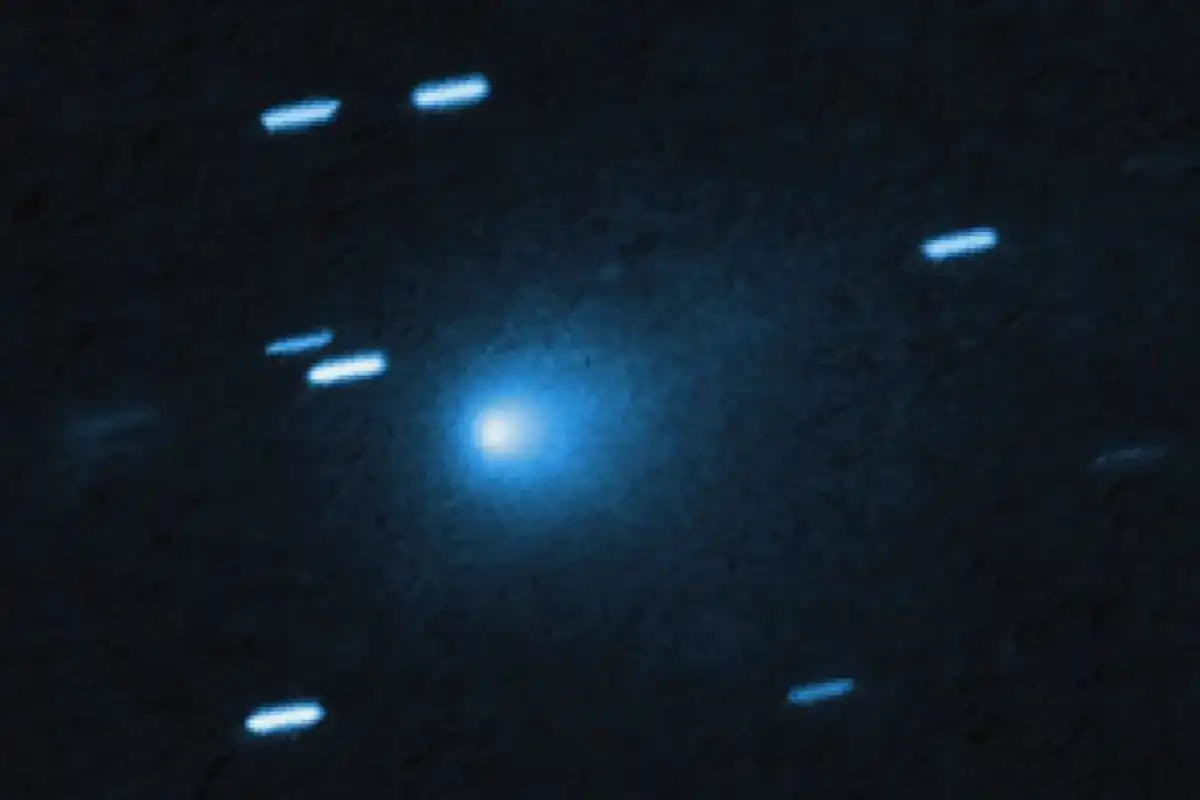
New Data Highlights Motion Anomalies in Interstellar Object 3I/ATLAS
New observations from the Hubble Space Telescope have revealed unusual motion patterns in the interstellar object 3I/ATLAS, offering unprecedented insight into its structure and behavior as it exits the solar system.
On December 27, 2025, Hubble captured a 170-second exposure using its Wide Field Camera 3 UVIS detector with the F350LP filter at a central wavelength of 0.5851 microns, according to USA Herald. The raw image shows a bright nucleus surrounded by a halo exhibiting asymmetrical elongation, differing from standard cometary profiles. The exposure indicates abrupt brightness falloff along certain axes and extended emission along others, suggesting directional activity rather than uniform outgassing. Earlier frames from July and November also display off-center brightness peaks, consistent with jet activity, USA Herald reports.
Asymmetry in Nucleus and Coma
Analysis of the December 27 frame shows the nucleus as a compact, bright source. The surrounding halo is elongated in a preferred direction, aligned with previously observed sunward anti-tail behavior. Brightness gradients decline unevenly along different axes. Background stars appear as streaks due to telescope tracking, confirming the asymmetry is intrinsic to 3I/ATLAS rather than instrumental effects, USA Herald notes. Comparisons with earlier frames show the central brightness peak offset from the halo’s geometric center, consistent with a narrow emission feature or jet oriented close to the observer’s line of sight.
Double-Jet Structure
Harvard Professor Avi Loeb reported that Hubble images from December 12 and 27, 2025, reveal a double-jet structure in 3I/ATLAS. The more prominent jet points sunward, corresponding to the previously documented anti-tail, while a weaker secondary jet is oriented opposite the main jet. Observations from July showed a sunward jet approximately ten times longer than it is wide, with a 7-degree wobble around the rotation axis. Post-perihelion images indicate the original Sun-facing pole now aligns with the weaker jet, while the stronger sunward jet emerges from the opposite side.
Jet Variability and Motion
The relative brightness and projected shape of the jets changed between December 12 and 27, possibly due to rotational wobble or variability in jet sources. The anti-tail jet brightens as the opposite jet weakens. Both jets remain constrained in size, and there is no broad fan-shaped dust tail typical of many outbound comets, USA Herald reports.
Controlled Geometry of Emission
Hubble data show 3I/ATLAS maintains a compact and directed emission pattern without chaotic dispersal of material. Directional emission aligns with earlier observations, documenting consistent jet activity over multiple months. Post-perihelion activity may differ from pre-perihelion patterns, with jets potentially originating from opposite sides or comprising material with varying particle sizes and velocities, Avi Loeb confirms.
The December 27 Hubble exposure provides detailed raw observational data, allowing measurement of asymmetries, jet orientation, and brightness offsets without post-processing, contributing to a comprehensive record of 3I/ATLAS’s motion and emission characteristics as it exits the solar system, Avi Loeb adds.
Catch all the Trending News, Breaking News Event and Trending News Updates on GTV News
Join Our Whatsapp Channel GTV Whatsapp Official Channel to get the Daily News Update & Follow us on Google News.
Must Read