
America Turned a Civilian Airport Into a Forward War Base; The Signal Washington Isn’t Saying Out Loud

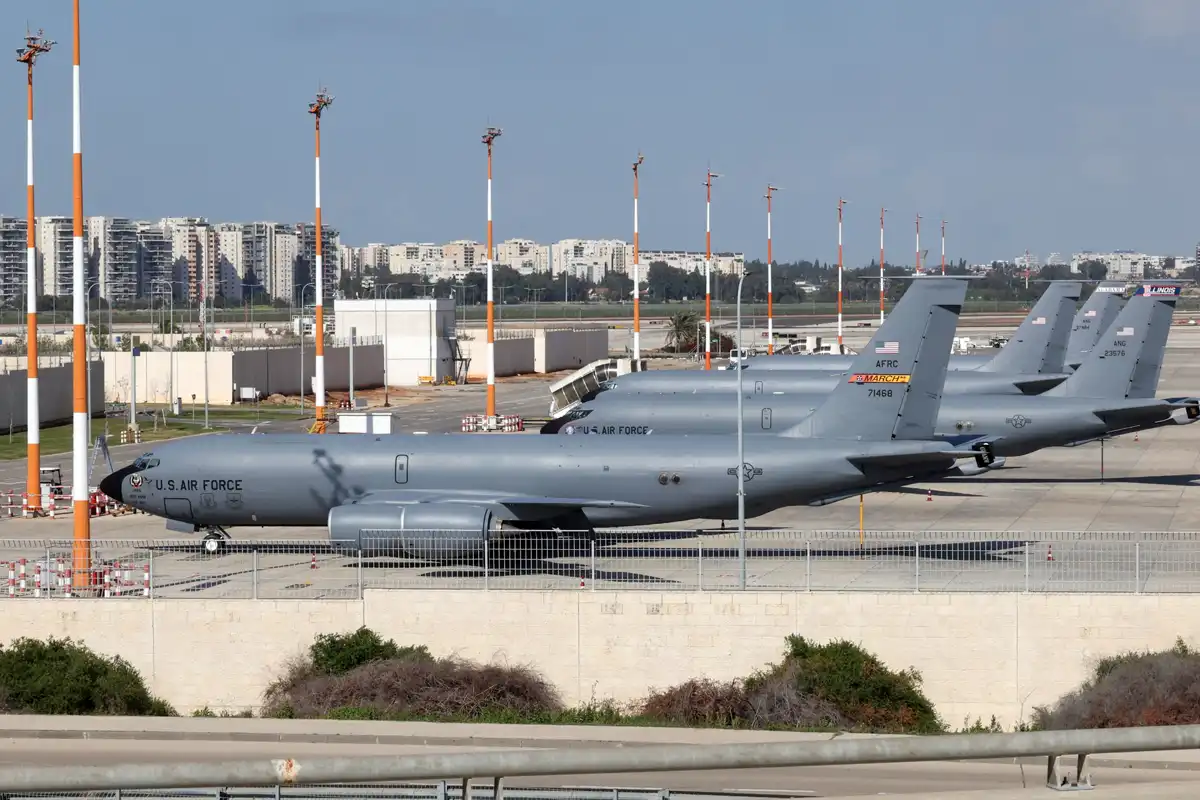
When footage emerged showing dozens of US Air Force refueling tankers lined up on the tarmac at Ben Gurion International Airport, Israeli aviation officials did not issue a routine statement. The head of the Civil Aviation Authority sent an urgent letter to the Transport Minister with a single, striking conclusion: Ben Gurion was no longer functioning as a civilian airport. It had become a military base.
That private letter said more than any Pentagon briefing.
What Tankers Actually Tell You
Aerial refueling aircraft are not defensive weapons. They do not intercept missiles or protect airspace. They exist for precisely one operational purpose: keeping strike aircraft in the air longer, flying farther, hitting harder — over targets that would otherwise be out of reach.
Fourteen American tankers — a mix of KC-46 Pegasus and KC-135 Stratotanker aircraft — arrived within a single week. The KC-135 has served as the backbone of US global power projection for decades. Its presence at a forward location signals that long-range, sustained air operations are being actively prepared, not merely considered.
Iran’s most hardened nuclear infrastructure sits well over a thousand miles from Israeli territory. Without aerial refueling support at scale, a sustained campaign against those sites is logistically impossible. With it, the mission envelope opens dramatically.
Diplomacy on One Track, Deployment on Another
American and Iranian negotiators were meeting in Oman for a second round of nuclear talks at almost the same moment the tankers were touching down in Tel Aviv. Those discussions ended without resolution. Another round was scheduled.
The simultaneous pursuit of diplomacy and forward military positioning is not contradictory — it is deliberate. Visible military deployment during active negotiations functions as a pressure instrument, signaling that the military option is not abstract but physically staged and operationally ready.
The strategic ambiguity this creates is intentional. Tehran must now calculate whether Washington is bluffing with hardware or whether the hardware is already the answer.
A Civilian Airport That May Not Recover
The military transformation of Ben Gurion carries costs that extend well beyond the current crisis. International airlines calculate risk continuously. When a major civilian hub begins operating on military schedules, with restricted zones, military traffic priority, and an indefinite US military presence projected through at least 2027, commercial carriers quietly begin rerouting.
Insurance premiums rise. Tourism calculates alternative destinations. The economic erosion is gradual but structural — and it does not reverse automatically when the military footprint eventually contracts.
Israel’s Parallel Push for Independence
Running alongside the American deployment is a significant Israeli strategic development: the delivery of Israel’s first domestically-designated KC-46 tanker, named “Gideon,” which completed its maiden flight recently and awaits formal handover. Israel has been heavily dependent on its aging refueling fleet and on American support for long-range operations.
The acquisition of its own modern tanker capacity represents a deliberate move toward operational independence — the ability to conduct extended strikes against distant targets without requiring US aircraft on Israeli runways. That independence changes the political calculus of any future decision to act unilaterally.
The Architecture of Something Longer
What is assembled at Ben Gurion is not a rapid-response contingency. Tanker deployments of this scale, combined with naval repositioning and basing timelines extending nearly two years, reflect planning for sustained operations — not a single decisive strike followed by withdrawal.
Militaries do not pre-position this kind of infrastructure for negotiations. They pre-position it because at some level of planning, the decision to use it has already been made — or is considered highly probable.
The tankers are not waiting indefinitely. They are waiting for an order.
Catch all the World News, Breaking News Event and Trending News Updates on GTV News
Join Our Whatsapp Channel GTV Whatsapp Official Channel to get the Daily News Update & Follow us on Google News.
Must Read


Pakistan
Bilawal Bhutto Pays Tribute to Karsaz Martyrs, Calls for Unity Against Terrorism
18-October،2026