
Iran asserts its right to self-defense in Strait of Hormuz, criticizes US actions

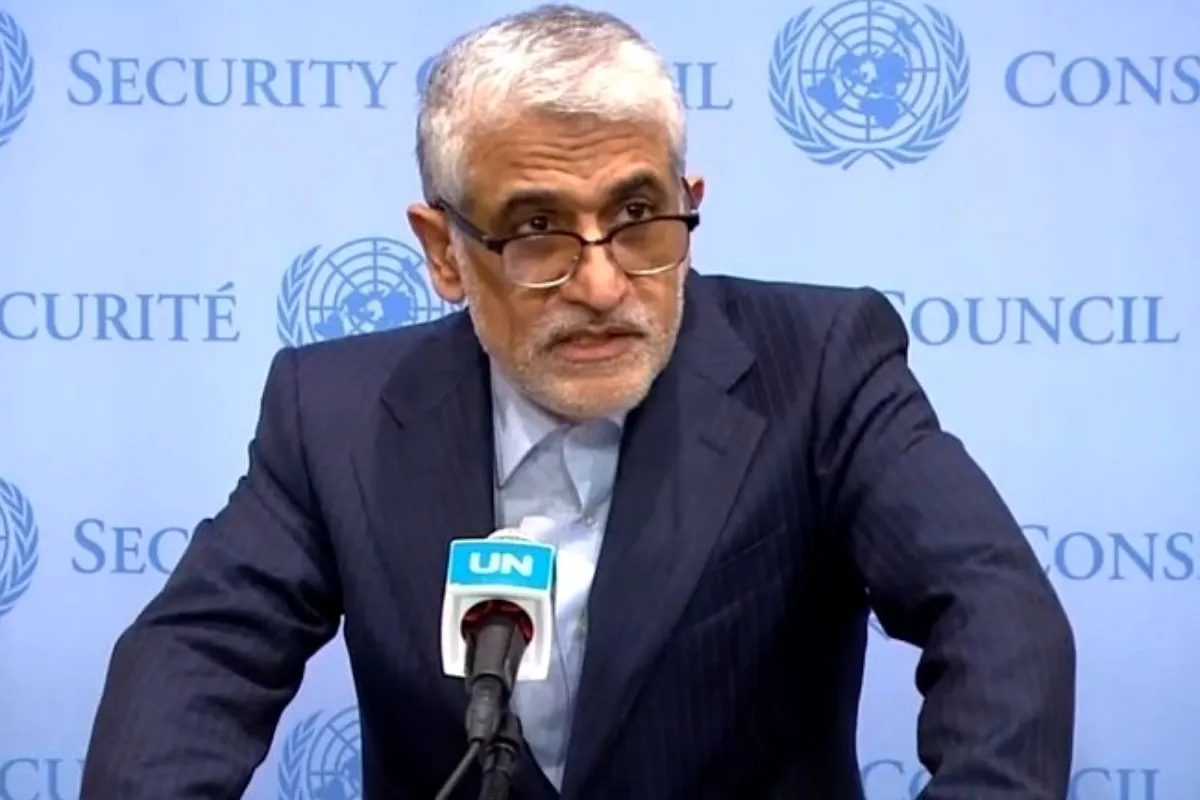
Iran asserts its right to self-defense in Strait of Hormuz, criticizes US actions
Iran Strait of Hormuz
Iran has emphasized its commitment to the principle of freedom of navigation, while stating that the current tensions in the region, particularly in the Strait of Hormuz, are caused by the destabilizing actions of the United States.
“Iran fully respects and remains committed to the principle of freedom of navigation under the law of the sea,” said Iran’s ambassador to the UN, Amir Saeid Iravani, at a UN Security Council Stakeout on Thursday.
He added, “However, the current situation in the region, including in the Strait of Hormuz, is not the result of Iran’s lawful exercise of its right of self-defense. Rather, it is the direct consequence of the destabilizing actions of the United States in launching aggression against Iran and undermining regional security.”
When asked about US Navy escorts through the Strait, Iravani said, “No, I have no response to that. Iran will exercise its inherent right to preserve peace and security in the Strait of Hormuz; that is our responsibility.” He also clarified, “As I said, we are not going to close the Strait of Hormuz. However, it is our inherent right to preserve peace and security in this waterway, and that is our right.”
Iravani criticized US and Israeli aggression against Iran, calling it part of a wider illegal and illegitimate war. “What is unfolding today is, in reality, an illegal and illegitimate war launched by Israel and the United States—two regimes that possess nuclear weapons—against a responsible non-nuclear-weapon State Party to the Treaty on the Non-Proliferation of Nuclear Weapons (NPT),” he said.
He noted that Israel has repeatedly claimed since 2003 that Iran was close to acquiring nuclear weapons, despite IAEA reports consistently refuting those claims. Iravani also condemned the US illegal military attack in June 2025 on Iran’s peaceful nuclear facilities, which were under IAEA safeguards, saying: “This illegal act constituted a clear violation of the UN Charter, the principles of international law, the IAEA Statute, the Agency’s relevant resolutions, and the NPT, which the US is a depositary.”
Iravani rejected attempts by the US and European allies to trigger the “snapback” mechanism of the JCPOA, calling it “baseless and a clear fabrication.” He also criticized the UN Security Council resolution against Iran, passed under US pressure, saying it ignored the real cause of regional tensions. “Yesterday was a shameful day for the Security Council,” he said, adding that the resolution unjustly targeted Iran instead of the aggressors.
He emphasized that the resolution demanded Iran refrain from exercising its inherent right to self-defense, which he said is “unlawful and entirely contrary to the Charter and international law.”
Regarding uranium enrichment, Iravani reaffirmed Iran’s stance, saying: “The claim that Iran has enriched uranium to 60 percent—the level allegedly required for producing a nuclear bomb—is a distortion of the facts and ignores the real root of the situation.” He explained that Iran increased enrichment levels only in response to violations by the US and European countries, aiming to compel them to return to their obligations.
Iravani concluded that Iran will continue to exercise its inherent right of self-defense under the UN Charter and international law, as the Security Council has failed to maintain international peace and security.
Iran Strait of Hormuz
Catch all the World News, Breaking News Event and Trending News Updates on GTV News
Join Our Whatsapp Channel GTV Whatsapp Official Channel to get the Daily News Update & Follow us on Google News.
Must Read

Pakistan
Ishaq Dar, Kuwait Foreign Minister Discuss Bilateral Ties, Regional Developments
7-September،2026