America’s Ammunition Crisis: How the Iran War Exposed the Hollow Core of US Military Readiness

The most powerful military on earth may have a dangerous shortage problem — and a sitting senator just said so out loud.
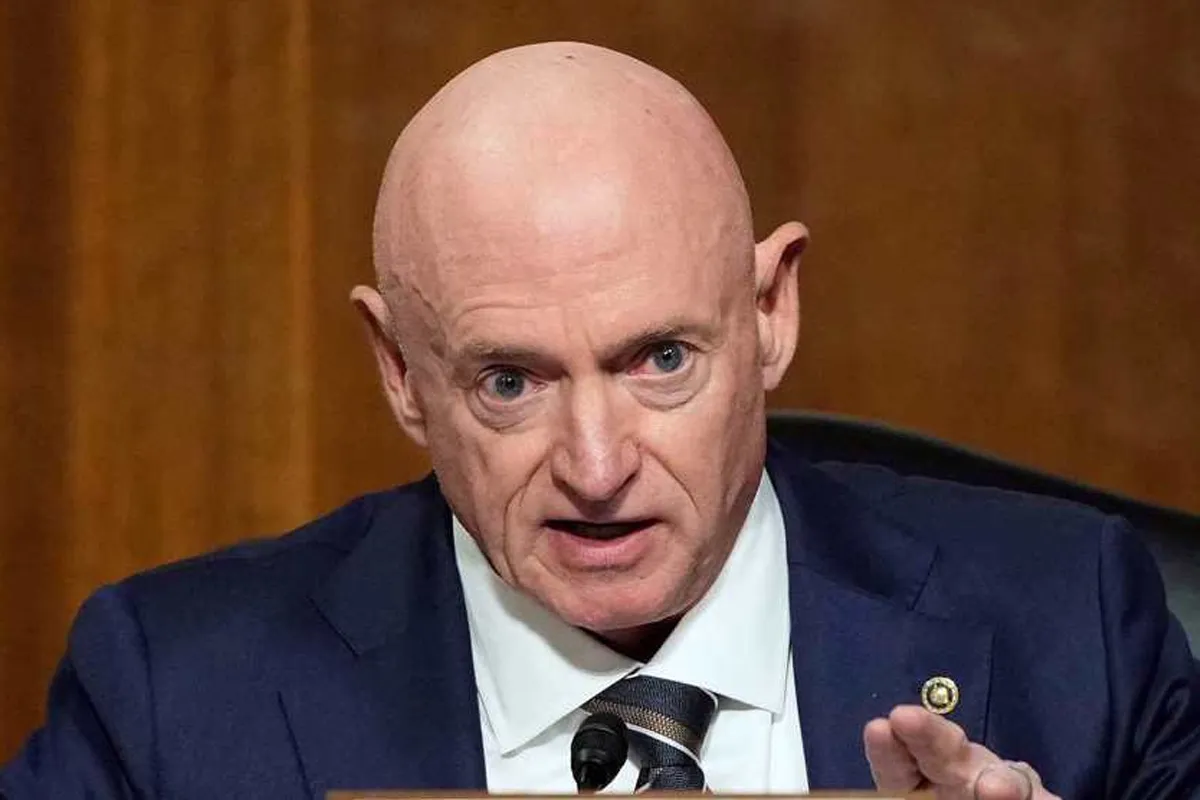
When a former Navy combat pilot and astronaut sits across from a network anchor and uses the word “shocking” to describe his own country’s weapons stockpile, that is not a talking point. That is a warning from someone who has seen the classified briefings and decided the public needs to know.
Senator Mark Kelly did exactly that on Sunday. What he described is not a temporary supply chain inconvenience. It is a structural readiness crisis — one that the war with Iran accelerated but did not create, now laid bare at the worst possible geopolitical moment.
What Kelly Actually Said — And What He Didn’t
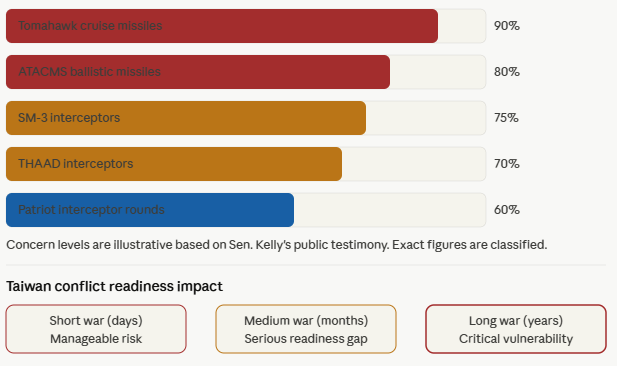
Speaking on CBS’s Face the Nation, Senator Kelly — a man whose résumé includes flying combat missions over Iraq and commanding the Space Shuttle — said Pentagon briefings on specific munitions had left him alarmed. He named the systems directly: Tomahawk cruise missiles, ATACMS, SM-3 interceptors, THAAD rounds, and Patriot missiles.
These are not niche weapons. They are the backbone of American power projection and missile defense. Tomahawks are used in virtually every sustained US strike campaign of the last three decades. ATACMS are the long-range ground-launched missiles that Ukraine begged for and received in limited quantities. SM-3 and THAAD are the systems that defend US naval assets and allied territory from ballistic missile attack. Patriot rounds defend American bases and allies from the kind of missile salvos Iran launched under Operation True Promise 4.
Kelly chose not to reveal classified specifics, but he said enough: the US has gone deep into these magazines, replenishment will take years for some systems, and if a future conflict lasted months rather than days, readiness would suffer meaningfully.
The war in Iran has reportedly cost at least $50 billion so far. That figure alone should concentrate minds.
The Deeper Problem: This Was Coming Before Iran
The munitions depletion that Kelly is describing did not begin on February 28. The US defense industrial base has been running at a production pace built for peacetime since the Cold War ended. The assumption — one that went largely unchallenged for 30 years — was that the US would never need to fight a sustained peer-level conflict requiring mass consumption of high-end precision munitions.
Ukraine shattered that assumption in 2022. The rate at which artillery shells, anti-armor missiles, and air defense interceptors were consumed in the first year of that war shocked Western defense planners. The US and its NATO allies began replenishing Ukrainian stocks and found, to their discomfort, that production lines could not keep pace with battlefield consumption.
Iran compounded an already stressed system. The difference between Ukraine and Iran is that in the latter case, the US was directly expending its own reserves rather than drawing down stockpiles designated for allied transfer. Every Tomahawk fired at an Iranian target is a Tomahawk the US Navy does not have for the next contingency.
The Taiwan Variable: Why the Timing Could Not Be Worse
Kelly’s mention of Taiwan was not accidental. It was the strategic subtext of everything he said.
Military planners and analysts have spent the last several years modeling what a Chinese military campaign against Taiwan would demand from US forces. The consistent finding across most serious assessments: the US would need to sustain high-volume strikes against Chinese naval and air assets, defend against Chinese ballistic and cruise missile attacks on US bases in Guam and Japan, and do so potentially for weeks or months. Every one of those missions consumes exactly the category of munitions that Kelly says are now depleted.
Kelly was careful with his language, saying that if a Taiwan conflict went on for months or years, the US would be in a worse position than it otherwise would have been. That framing understates the concern that serious analysts privately express. The issue is not just that stocks are lower — it is that the production lead times for many of these systems are measured in years, not months. A Tomahawk takes roughly two years to manufacture from order to delivery under current industrial arrangements. THAAD interceptors are similarly slow to produce. If a Taiwan conflict began today and lasted eighteen months, the US would be fighting the second half of it with a shrinking magazine and limited ability to restock in real time.
Kelly vs. the $1.5 Trillion Defense Budget
There is an apparent paradox at the heart of this story. The Trump administration has requested a $1.5 trillion defense budget — the largest in American history. How can the US be running short of munitions while simultaneously seeking record defense spending?
Kelly’s answer is pointed. He called the request “outrageous” and specifically attacked the Golden Dome missile defense initiative — a project aimed at creating a space-based and ground-based layered shield over the continental United States. His objection is not ideological but technical. The physics of intercepting ballistic missiles at scale, particularly hypersonic ones, remain deeply unsolved. The risk, in Kelly’s framing, is that massive sums get allocated to a system that provides political reassurance without operational capability — while the more unglamorous work of rebuilding conventional stockpiles goes underfunded.
This is a real tension inside US defense planning. Transformative programs — stealth aircraft, next-generation ships, space-based defense — consume enormous resources and produce capability years or decades later. Rebuilding munitions stockpiles is less photogenic but more immediately relevant to near-term readiness. The question of how to balance these demands is not new, but the Iran war has made it urgent.
The JCPOA Thread: How a Nuclear Deal Became a Munitions Crisis
Kelly’s political framing attributes the current situation directly to Donald Trump’s 2018 withdrawal from the Joint Comprehensive Plan of Action — the Obama-era nuclear agreement that constrained Iran’s enrichment program in exchange for sanctions relief. His argument: the JCPOA was working, Trump killed it, Iran accelerated its nuclear program, and the subsequent pressure campaign failed to produce a better deal, eventually escalating into the conflict that began on February 28.
Whether one accepts that causal chain fully or partially, the downstream consequence is undeniable. A diplomatic framework that kept Iran’s nuclear program constrained without a single Tomahawk being fired is now gone. In its place is a 40-day war, a fragile ceasefire, an ongoing naval blockade, and a depleted US munitions inventory.
The cost of not having a nuclear deal turned out to be $50 billion, years of production lead time, and an uncertain regional equilibrium — at minimum.
What the Ceasefire Doesn’t Solve
The Pakistan-brokered ceasefire that took hold in early April paused the active exchange of strikes, but the structural conditions that produced the war remain entirely in place. The US naval blockade of Iranian ports continues, meaning Iran is still experiencing wartime economic pressure. Iranian officials continue to issue warnings about airspace and territorial water violations — warnings they have backed with action, as the drone intercept on Monday demonstrated.
A ceasefire under these conditions is better understood as a pause than a resolution. The two sides stopped hitting each other directly, but neither the underlying nuclear dispute, nor the sanctions architecture, nor Iran’s regional posture has changed. The next escalation trigger is not a question of if but when and what kind.
For US military planners, the worst-case scenario is a resumption of hostilities before stockpiles are replenished. That is the window of vulnerability Kelly is trying to draw attention to.
The Industrial Base Question No One Wants to Answer
The hardest part of Kelly’s warning is also the least discussed: fixing this is slow. The US defense industrial base was deliberately rationalized after the Cold War — companies consolidated, production lines closed, and the assumption of “just enough, just in time” replaced Cold War-era surge capacity.
Rebuilding that capacity requires more than money. It requires trained workers, supply chains for specialized components, physical factory space, and time. The Pentagon has been aware of these constraints for years and has taken incremental steps — multi-year procurement contracts, investments in domestic propellant production, efforts to expand the Tomahawk production line. But incremental is the operative word. The Iran war consumed stockpiles faster than the incremental investments can replace them.
There is no quick fix. The senator knows that. His goal on Sunday was not to propose a solution — it was to make clear that a problem exists, that it is serious, and that the public deserves to know before the next crisis finds the US in an even weaker position.
The Real Cost of the Iran War Is Still Being Counted
The ceasefire is holding. The strikes have stopped, for now. But the ledger of the Iran war is far from closed. The financial cost stands at $50 billion and climbing. The strategic cost — in depleted stockpiles, strained alliances, and reduced deterrence credibility — is harder to quantify but potentially larger.
Senator Kelly is not a dove. He is a combat veteran and former astronaut who has spent years on the Senate Armed Services Committee. When someone with that background uses the word “shocking” in public about his own country’s military readiness, the appropriate response is not to treat it as partisan noise.
It is to ask: how did the most powerful military in history allow itself to get here — and how long will it take to get back?
Those are questions that $1.5 trillion budgets and Golden Dome press releases do not answer. They are questions that will determine whether American deterrence remains credible across the next decade of genuine great-power competition.
Dislcaimer; This article is based on publicly available statements, open-source reporting, and historical defense procurement data. Classified figures regarding exact stockpile levels have not been referenced or estimated.
Catch all the World News, Breaking News Event and Trending News Updates on GTV News
Join Our Whatsapp Channel GTV Whatsapp Official Channel to get the Daily News Update & Follow us on Google News.
Must Read