
No Exit: How Trump’s Rejection of Iran’s Peace Terms Locks America Into a Strategic Deadlock

Trump Transfers Venezuelan Uranium in Joint Operation While Iran Nuclear Objective Remains Unfulfilled Amid Global Tensions
Washington entered this war with a list of objectives. Seventy days later, none of them have been achieved — and the path out just got narrower.
There is a particular kind of strategic trap that is most dangerous precisely because it does not announce itself. It arrives quietly, dressed as a negotiation, submitted through intermediaries, and carrying a deadline that the trapped party does not recognize as a deadline. Iran’s comprehensive peace proposal, delivered through Pakistani mediators on Sunday, was that kind of document. And when Donald Trump rejected it via social media — with the casual confidence of a man who believes momentum is on his side — he may have ensured that the worst chapter of this conflict is still ahead.
Seventy days into a war that began on February 28, the United States faces a reckoning that its public posture has not caught up with. The gap between what Washington said it would accomplish and what it has actually accomplished is not a communications problem. It is a strategic one. And Trump’s dismissal of Tehran’s proposal has not closed that gap — it has widened it.
What Iran Actually Proposed — And Why It Is Not Irrational
Before analyzing what Washington rejected, it is worth examining what Tehran actually put on the table, because the framing matters enormously.
Iran’s proposal, submitted through Islamabad, contained five core elements: payment of war reparations for damage to Iranian infrastructure and civilian populations; formal recognition of Iranian sovereign management over the Strait of Hormuz based on mechanisms Tehran had already announced; the complete removal of US-imposed sanctions; the return of frozen Iranian assets; and a permanent cessation of hostilities extending not only to Iran but to affiliated forces across the region, including in Lebanon.
None of these demands emerged in a vacuum. Each one maps directly to a specific grievance with a documented history. The frozen assets predate the current conflict by decades, rooted in disputes stretching back to 1979. The sanctions architecture that Iran wants dismantled has been built layer by layer across multiple administrations and spans energy exports, banking, shipping, and technology. The Strait of Hormuz question reflects the geographic reality that Iranian territory flanks the waterway through which roughly 20 percent of global oil supply transits.
Whether one regards these demands as reasonable or ambitious, they are not incoherent. They form a logically consistent package from the perspective of a nation that believes it absorbed an unprovoked military assault and held the line.
What Washington Counter-Proposed — And What It Reveals
The American counter-proposal is striking primarily for what it ignores. Rather than addressing the war that has been fought for 70 days, Washington’s terms largely revert to the pre-war nuclear negotiating agenda as if February 28 never happened.
The US is seeking closure of Iranian nuclear facilities, a long-term halt to uranium enrichment, and transfer of enriched uranium stockpiles to American custody. These are maximalist demands on the nuclear file — demands that Iran rejected before the war began, under far greater economic pressure, and which have not become more achievable because American cruise missiles struck Iranian territory.
What is absent from the American proposal is as revealing as what is present. There is no acknowledgment of civilian casualties. No offer of reparations. No commitment to withdraw US naval assets from the blockade posture. No guarantee framework against future military action. No mechanism for lifting sanctions. The proposal essentially asks Iran to surrender its most sensitive strategic asset — its nuclear program — while offering nothing in exchange that addresses the war’s actual consequences.
This is the negotiating posture of a party that believes it is winning. The evidence that the US is winning is, at minimum, contested.
The Objectives Audit: What the War Was Supposed to Achieve
Any honest assessment of where this conflict stands requires measuring current reality against the stated objectives with which it began. Those objectives, as articulated by the administration and its supporters in the early days of the war, included: forcing a change in Iranian political leadership, destroying or permanently disabling Iran’s ballistic missile program, eliminating Iran’s nuclear infrastructure, and establishing US-friendly terms for Strait of Hormuz navigation.
Seventy days later, the Iranian government remains in place and reports indicate public support for the armed forces has been substantial. Iran’s missile capabilities, while tested, have demonstrated range and volume sufficient to strike American bases across the region in 100 documented waves of strikes under Operation True Promise 4. The nuclear infrastructure situation remains contested — Iran acknowledges damage to some facilities but claims its enrichment capability continues. And Iranian officials have consolidated rather than surrendered their position on Strait of Hormuz management.
This is not the picture of a campaign approaching its objectives. It is the picture of a strategic stalemate in which one side is absorbing costs and claiming victory while the other side has submitted a peace proposal and set its terms.
The Three Paths and Why Each One Is Difficult
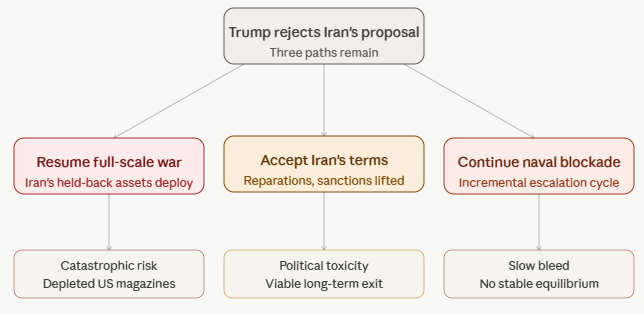
Trump’s rejection of Iran’s proposal has not created new options. It has clarified that the existing options are all costly, and forced Washington to choose among them without the cover of ongoing negotiation.
The path of renewed escalation carries the highest immediate risk. Iran has been explicit, through its Khatam al-Anbiya Central Headquarters, that any resumed full-scale campaign would be met with capabilities and tactics that were deliberately withheld during the first 40 days of active hostilities. Whether this represents genuine strategic reserve or sophisticated deterrence messaging is difficult to assess from open sources — but the claim itself shapes the decision calculus of any US commander considering escalation options. The military and economic costs of the first round — Senator Mark Kelly described US munitions depletion as “shocking” in a separate congressional intervention — make a second round a proposition with very different risk parameters than the first.
The path of accepting Iran’s terms is politically toxic for the current administration in a way that goes beyond ordinary diplomatic concession. The Trump political identity is built on a specific narrative of maximum pressure producing maximum results. Paying reparations to Tehran, accepting Iranian sovereignty over the Strait of Hormuz, and releasing frozen assets would constitute the most explicit acknowledgment of strategic defeat by an American president in the modern era. That it might also be the most pragmatic available outcome does not make it politically viable in the near term.
The path of continuing the naval blockade in its current form — neither escalating nor de-escalating — is the default choice and the most immediately comfortable one. But comfort and sustainability are different things. Iran has made its position on the blockade mathematically clear: each intercepted or attacked vessel triggers a corresponding response against American assets. An indefinite blockade is not a stable equilibrium. It is a slowly escalating confrontation operating below the threshold of declared renewed hostilities, degrading US regional interests incrementally while creating ongoing flashpoints.
The Economic Lever Iran Has Already Pulled
One dimension of this conflict that receives insufficient attention in security-focused analysis is the economic architecture Iran has been operating within since the war began.
Oil prices have exceeded $110 per barrel in the period since hostilities began — a level that triggers inflationary pressure across virtually every major economy, since energy costs flow through to manufacturing, transportation, agriculture, and consumer goods. The mechanism is straightforward: the Strait of Hormuz handles roughly 20 percent of global seaborne oil trade. Any uncertainty about its navigability, any insurance premium adjustment for vessels transiting the Gulf, any actual or threatened interdiction changes the global price calculus.
Iran did not need to close the Strait entirely to generate this effect. The announcement of sovereign management mechanisms, combined with the active conflict, was sufficient to move markets. That represents a highly cost-efficient form of economic leverage — one that Iran can sustain indefinitely as a background pressure on the global economy without firing a single additional missile.
The political consequence of sustained $110 oil is not distributed equally. American consumers feel it at the pump and in grocery prices. European allies face energy cost surges that strain already fragile economic recoveries. Asian importers — including China, Japan, South Korea, and India — watch their energy bills climb. The diplomatic pressure this generates does not fall on Tehran. It falls on Washington, as the party that initiated and now sustains the conflict.
This is not an accidental byproduct of Iranian strategy. It is the strategy.
Pakistan’s Role — And Its Limits
The involvement of Pakistan as the ceasefire broker and proposal intermediary deserves more analytical attention than it has received. Islamabad occupies a genuinely unique position: it has functional diplomatic relationships with both Tehran and Washington, shares a border with Iran, maintains close economic ties with Gulf states, and operates within a regional framework that includes both Chinese and American strategic interests.
Pakistan’s ability to broker the current ceasefire was a significant diplomatic achievement. Its ability to transmit Iran’s proposal to Washington represents a continued good-faith intermediary role. But Pakistan’s leverage is limited. Islamabad cannot compel Washington to accept terms it finds unacceptable, and it cannot prevent Tehran from taking actions it deems justified if negotiations collapse.
The erosion of Pakistan’s mediating position — which would occur if either party took steps that rendered diplomatic communication moot — would remove one of the few stabilizing mechanisms currently operating in the conflict. This is a risk that neither side has publicly acknowledged but both understand.
The Historical Parallels That Should Concern Washington
American strategic history contains instructive examples of what happens when the gap between stated objectives and achievable outcomes goes unacknowledged for too long. The pattern is consistent: the longer the gap persists, the higher the eventual cost of closing it — whether through negotiated settlement, unilateral withdrawal, or defeat.
The conditions that allowed smaller parties to successfully impose costs on larger ones — geographic advantage, asymmetric tolerance for casualties, distributed command structures, external supply lines, and high domestic legitimacy — are conditions that Iran possesses in meaningful measure. Geography alone is significant: Iran’s mountainous interior, dispersed military infrastructure, and proximity to the Strait give it structural defensive advantages that airpower has historically struggled to neutralize permanently.
None of this means Iran is invincible or that its strategic position is without vulnerability. But it does mean that the assumption underlying Trump’s rejection of the peace proposal — that continued pressure will eventually produce Iranian capitulation — has limited historical support when applied to similarly configured conflicts.
What a Negotiated Exit Would Actually Require
If the analysis above is approximately correct — that resumed escalation carries catastrophic risk, that indefinite blockade is unsustainable, and that some form of negotiated settlement is the least bad available outcome — then the relevant question becomes what such a settlement would actually look like and what it would cost Washington politically.
The core concessions would be significant but not unprecedented. Paying reparations is something the US has done before, under different names and through different mechanisms — the Algiers Accords of 1981 that resolved the hostage crisis included financial settlement of Iranian claims. Releasing frozen assets addresses something that many international legal scholars regard as having been legally questionable from the start. Lifting sanctions in exchange for security commitments has been the template for every nuclear negotiation involving Iran over the past two decades.
The Strait of Hormuz question is the most complex, because recognizing Iranian sovereign management mechanisms requires acknowledging a shift in regional power reality that Washington has resisted. But again, this is a recognition of existing geographic fact rather than a creation of new Iranian capability. Iran’s position at the Strait is not a product of this war — it is a permanent geographic condition that predates the Islamic Republic.
The political cost of accepting these terms is real. But the political cost compounds with time. Every week that the current stalemate continues is another week in which the gap between Trump’s victory posture and observable reality widens — and another week in which the eventual settlement, if it comes, will look more like surrender than negotiation.
The Trap Is Already Closed
The title of the Iranian proposal’s rejection story, in retrospect, may not be about the dramatic gesture of Trump’s social media post. It may be about something quieter and more consequential: the moment at which the available exit routes from a losing strategic position began to close, one by one.
Iran’s proposal remains on the table. Tehran has made that clear. But proposals do not wait forever, and the terms available today are not guaranteed to remain available after the next escalation cycle, the next incident at sea, or the next shift in the regional balance that this conflict has already set in motion.
Washington entered this war with ambitious objectives and a theory of rapid coercive success. Seventy days later, the theory has not produced the success. The objectives remain unachieved. The costs — financial, military, diplomatic, and reputational — continue to accumulate. And the administration has just rejected the most concrete off-ramp yet offered.
The trap, to use the framing that international observers have increasingly adopted, is not something Iran set in advance. It is something that assembled itself from a sequence of strategic miscalculations, each of which seemed defensible in isolation and collectively produced a position from which there is no costless escape.
History will not record who was stronger. It will record who made better decisions when better decisions still had value.
Disclaimer; This analysis reflects open-source reporting, public statements from officials on all sides, and independent strategic assessment. It does not represent the position of any government. Classified military assessments have not been referenced.
Catch all the World News, Breaking News Event and Trending News Updates on GTV News
Join Our Whatsapp Channel GTV Whatsapp Official Channel to get the Daily News Update & Follow us on Google News.
Must Read