
US $12 Billion Plan Creates New Concerns for Defence Industry

US $12 Billion Plan Creates New Concerns for Defence Industry
WASHINGTON: Trade and strategic tensions between the United States and China have reached a critical area involving fighter jets, missiles, radar systems, advanced electronics and defence manufacturing.
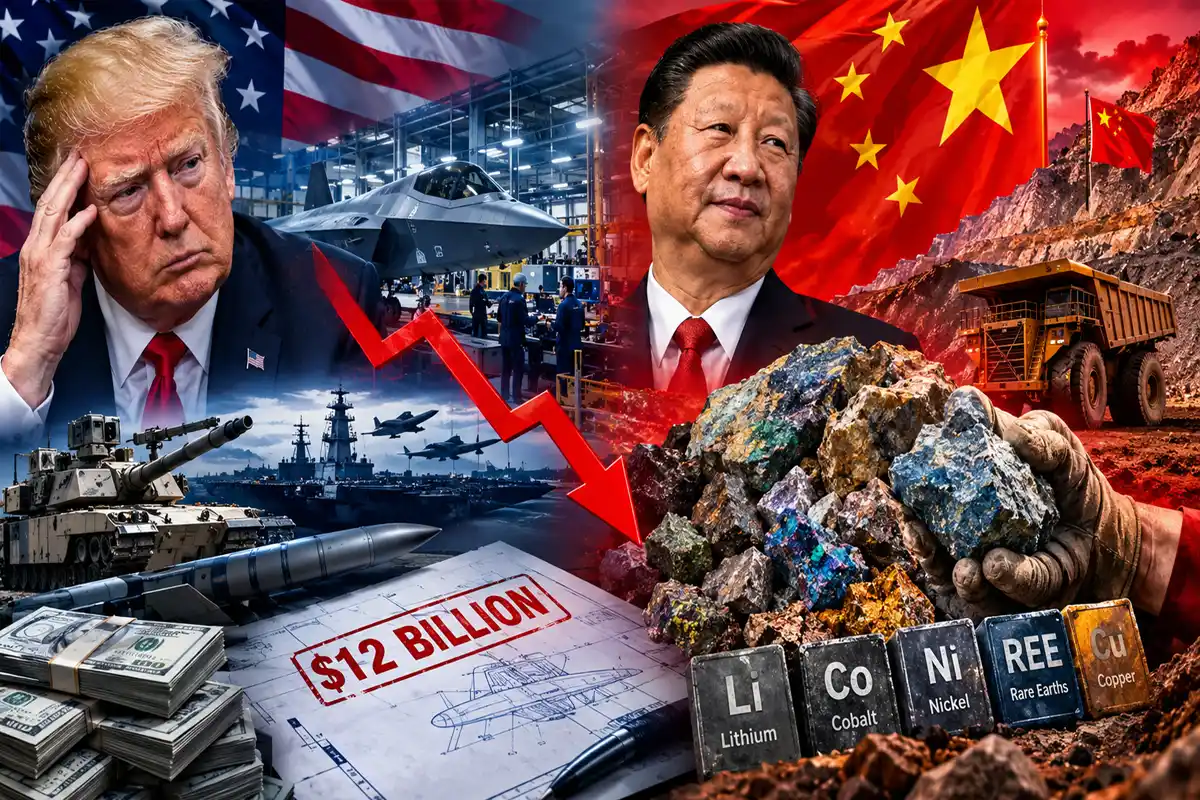
According to a Financial Times report published on October 9, a major US aerospace and defence industry group has warned that Project Vault, a $12 billion plan to build strategic reserves of critical minerals, could put further pressure on already limited global supplies.
The warning has raised concerns that the US government’s efforts to secure essential minerals could make them more expensive and harder for manufacturers to obtain.
What Is Project Vault?
Project Vault is a plan linked to the US Export-Import Bank that aims to establish strategic reserves of critical minerals.
These reserves would help protect American industries against sudden disruptions in global supplies. Civilian manufacturers could also benefit when minerals become difficult to obtain.
However, defence industry representatives fear that large-scale government purchases could increase competition for limited supplies and push prices higher for companies that need these materials for production.
Why Are US Defence Companies Concerned?
The Aerospace Industries Association, which represents companies across the American aerospace and defence sectors, has warned that Project Vault could create additional competition between government buyers and industrial manufacturers.
The organisation has called for greater clarity and changes to the programme to prevent it from creating further difficulties for businesses.
The warning comes as Chinese export restrictions and rising global demand are already putting pressure on the availability and prices of several critical minerals.
US Dependence on China Remains a Major Concern
The United States has advanced defence technology but continues to depend on foreign suppliers for the mining, processing and production of several important minerals.
China has a particularly strong position in rare earth processing and the production of permanent magnets.
These magnets are used in fighter jets, electric motors, guidance systems, industrial machinery and other advanced equipment.
According to 2025 figures cited in the report, the US used approximately 48,000 metric tonnes of rare earth magnets, while domestic production stood at around 300 metric tonnes.
This gap highlights the challenge of building alternative supply chains quickly.
New US Restrictions From January 2027
Another major challenge for the US defence industry will begin on January 1, 2027.
Under US defence procurement rules, restrictions on certain materials and magnets mined, processed or produced in China, Russia, Iran and North Korea will expand from that date.
The restrictions cover specific permanent magnets, tungsten products and tantalum metals and compounds.
Some exceptions and special permissions may be available under certain circumstances.
However, industry representatives have warned that a lack of alternative suppliers could make full compliance by the deadline difficult. They have called for an extension and the retention of necessary exemptions.
Why Are Tungsten, Antimony, Gallium and Germanium Important?
The supply problem extends beyond rare earth elements.
- Tungsten: A hard metal that can withstand high temperatures. It is used in certain types of ammunition, industrial tools and defence components.
- Antimony: Used in some ammunition, metal alloys and fire-resistant materials.
- Gallium: Important for semiconductors, radar systems, radio-frequency technology and advanced defence electronics.
- Germanium: Used in infrared imaging systems, specialised equipment and some communications technologies.
Shortages of these minerals could affect the production of certain defence products, although not every weapon requires all four materials.
Could a Long War With Iran Create More Problems?
Defence industry reports published in March warned that disruptions in supplies of tungsten, antimony, gallium and germanium could become a strategic weakness for the United States during prolonged military operations.
Peter Clausi, director of Canada’s Critical Minerals Institute, warned that severe shortages could limit the production of new defence equipment.
However, these concerns do not mean that production of all US weapons has stopped.
The main risk is that if existing reserves decline, alternative suppliers remain unavailable and military demand increases, the production of certain defence systems could become slower and more expensive.
Can the US Quickly Reduce Its Dependence on China?
The United States is investing in new mines, mineral processing facilities and permanent magnet manufacturing.
However, developing a mineral resource and bringing it into commercial production can take several years.
Defence manufacturers also need processed materials that meet specific quality and technical standards, rather than just raw minerals.
As a result, even with significant investment, the United States may find it difficult to eliminate its dependence on China in the short term.
A Double Challenge for Washington
The US government wants to reduce the defence industry’s dependence on foreign mineral supplies. At the same time, manufacturers need a steady supply of affordable materials to maintain production.
Project Vault aims to address this challenge, but industry representatives fear that an unsuitable purchasing strategy could raise prices and increase the cost of defence equipment.
The situation highlights that modern military strength depends not only on fighter jets, missiles and defence budgets but also on the minerals and supply chains needed to manufacture advanced weapons.
As competition between the United States and China intensifies, critical minerals are becoming an increasingly important issue for national security, industrial independence and future military readiness
Catch all the World News, Breaking News Event and Trending News Updates on GTV News
Join Our Whatsapp Channel GTV Whatsapp Official Channel to get the Daily News Update & Follow us on Google News.
Must Read