Epstein Files New York Exhibit 2026 — All 3.5 Million Pages on Display in Tribeca Pop-Up Library


Epstein Files New York Exhibit 2026 — All 3.5 Million Pages on Display in Tribeca Pop-Up Library
Most government document releases disappear into digital archives, read by specialists and ignored by the public. A Washington-based nonprofit decided that was insufficient. The Institute of Primary Facts has printed, bound, and physically displayed every page of the Jeffrey Epstein files released by the US Department of Justice — all 3.5 million of them — in a temporary library in Tribeca, New York, open to visitors until May 21, 2026. The name they gave it makes the political intent explicit: the Donald J Trump and Jeffrey Epstein Memorial Reading Room.
What the Exhibit Actually Contains
The display houses 3,437 numbered, bound volumes containing the complete document release authorised under the Epstein Files Transparency Act. Every volume is organised and shelved — a physical materialisation of a dataset that most people have only encountered as an abstract reference to a massive digital file.
The Institute’s website states its philosophy plainly — that truth becomes harder to deny when it is physically present, printed, and structured for direct engagement. The exhibit is not an art installation. It is a functional reading room built around a single primary source.
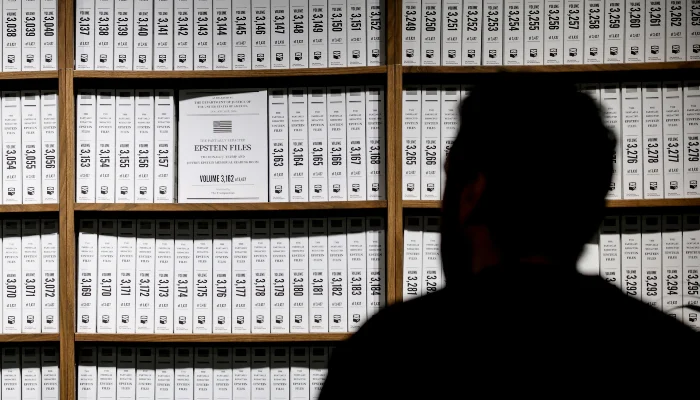
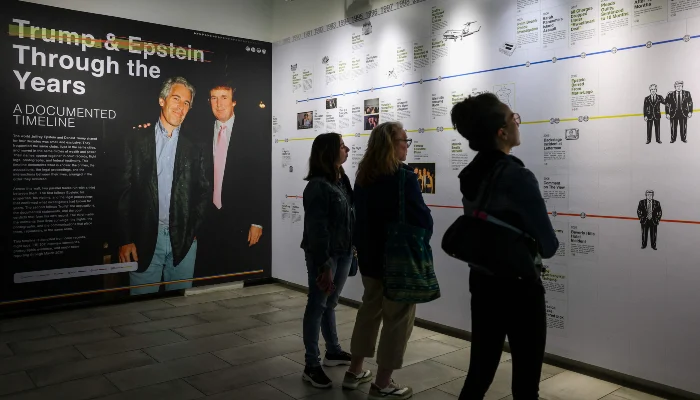
Access is not unlimited. Due to a significant procedural failure by the Department of Justice — which neglected to properly redact the names of some victims included in the documents — general public browsing of the files themselves is restricted. Verified professionals including journalists and lawyers are granted exceptions. General visitors can register online to enter and view the exhibit’s surrounding displays, including a dedicated section examining the documented relationship between President Trump and Epstein.
The Trump-Epstein Timeline: What the Exhibit Presents
The exhibit includes a visual timeline of the Trump-Epstein relationship — a friendship that spanned decades before reportedly fracturing in 2004 over a disputed Florida property deal. Following that split, Trump reportedly distanced himself publicly from his former associate. Epstein died in federal custody in August 2019 while awaiting trial on federal sex trafficking charges involving minors — a death officially ruled a suicide but contested by numerous investigators and family representatives.
Trump has consistently denied any wrongdoing despite appearing repeatedly throughout the released files. The exhibit does not adjudicate guilt — it presents the documented record and allows visitors to draw their own conclusions from primary sources rather than media summaries.
Why a Physical Exhibit Rather Than a Digital Campaign
David Garrett, one of the project’s creators, explained the strategic logic to AFP directly. Digital releases produce momentary attention cycles — a news spike, social media engagement, and then rapid disappearance from public consciousness. Physical presence operates differently. A room full of bound government documents creates a visceral encounter with scale and institutional accountability that a database URL cannot replicate.
Garrett described the Institute as a pro-democracy organisation focused on in-person public education experiences designed to make governmental corruption tangible rather than abstract. His stated goal is to generate the kind of sustained public pressure that forces accountability — something he believes the Trump administration’s handling of the document release has so far avoided.
The redaction failures by the DOJ — which directly caused the public access restrictions at this exhibit — have themselves become a focal point of criticism. Transparency advocates argue that the errors were not merely bureaucratic incompetence but reflect a pattern of deliberate obstruction in how the files were processed and released. Garrett’s comments about needing real public outcry around the administration’s document handling suggest the exhibit is designed as much to highlight what is missing from the files as what is present.

Historical Context: Comparing Epstein File Releases
The Epstein case has generated multiple waves of document release over several years — court filings, flight logs, deposition transcripts, and now the comprehensive DOJ release. Each wave has produced significant media coverage but limited concrete accountability for the network of powerful individuals documented in the materials.
The physical exhibit model has precedent in journalism and activism — WikiLeaks’ cable releases were similarly printed and distributed in book form by some publishers — but the Tribeca display is unusual in its scale and its deliberate naming strategy, which fuses Trump’s identity with Epstein‘s in a way that forces every visitor to confront that association before entering.
FAQ
Who can visit the exhibit? Anyone can register online to visit. Full document access is restricted to verified professionals due to DOJ redaction failures.
Where is it located? Tribeca, New York City.
When does it close? May 21, 2026.
Who organised it? The Institute of Primary Facts, a Washington-based nonprofit transparency advocacy organisation.
Catch all the World News, Breaking News Event and Trending News Updates on GTV News
Join Our Whatsapp Channel GTV Whatsapp Official Channel to get the Daily News Update & Follow us on Google News.
Must Read

Pakistan
UN warns of escalating tensions on Lebanon-Israel border as Gaza sees major aid delivery
4-September،2026

Pakistan
Ogdc posts record rs242.37bn profit, up 42.7pc, nine new oil and gas discoveries
4-September،2026