
Che Guevara: The Revolutionary Who Challenged the World

On October 9, 1967, Ernesto “Che” Guevara was executed in Bolivia at the age of 39. Nearly six decades later, his life continues to provoke admiration, debate, and reflection. For some, he remains a symbol of resistance against imperialism and economic exploitation; for others, his revolutionary violence and political authoritarianism represent the dangers of ideological absolutism. Yet beyond the mythology, Che deserves serious study as a physician who became a revolutionary, an intellectual who questioned established economic systems, and a political actor who attempted to transform his convictions into historical reality.
Che’s significance lies not simply in the fact that he fought with a rifle, but in the relationship he established between thought and action. He challenged young people to look beyond personal advancement and examine the social conditions that determine human opportunity. His life raises a fundamental philosophical question: can an individual remain indifferent to injustice after acquiring the knowledge necessary to understand it? Che answered that question through revolutionary commitment, although the consequences of his methods remain deeply contested.
Born on June 14, 1928, in Rosario, Argentina, Ernesto Guevara grew up in a middle-class family with intellectual interests and left-leaning political sympathies. Despite suffering from asthma, he pursued an active life, cultivated a passion for literature, and studied medicine at the University of Buenos Aires. His medical education provided him with scientific discipline and an understanding of the human body, but his encounters with poverty gradually expanded his conception of illness. He began to see suffering not merely as a medical condition but as a social phenomenon connected to deprivation, inequality, and the distribution of resources. This transformation illustrates an important distinction between education and intellectual awakening. Education supplies knowledge; intellectual awakening compels a person to reconsider the world through that knowledge. A medical student may learn how to treat disease, but a socially conscious physician may also ask why certain communities suffer disproportionately from preventable illness. Che increasingly regarded poverty as something that could not be understood exclusively through individual circumstances. He connected it to the organization of society and the unequal distribution of wealth and power.
His intellectual development was influenced by Marxist thought, Latin American political history, revolutionary nationalism, and humanist literature. His interest in philosophy was not detached from practical experience. He wanted to understand the mechanisms through which societies reproduce inequality and whether those mechanisms could be transformed. For young people, Che’s education offers a valuable lesson: professional excellence need not end with personal achievement. A degree can become a tool for social understanding rather than simply a certificate of individual success. However, intellectual commitment also requires the ability to question one’s own assumptions. Education becomes truly transformative when it develops not only conviction but also humility, critical thinking, and an openness to evidence.
Che’s journey across South America with his friend Alberto Granado, beginning in December 1951, became one of the formative experiences of his life. The journey took him through several Latin American countries, exposing him to the lives of miners, rural workers, Indigenous communities, and people excluded from economic security. His experiences later informed The Motorcycle Diaries, published posthumously in 2003 and adapted into a film in 2004. The importance of this journey extends beyond travel. It represented a movement from observing society as an outsider to identifying himself with the suffering he encountered. The continent gradually appeared to him less as a collection of separate national territories and more as a connected historical space shaped by shared experiences of colonialism, dependency, and inequality.
Philosophically, this development can be understood through the idea that consciousness emerges through encounters with reality. Abstract ideas about justice acquire a different meaning when one encounters people whose lives are constrained by hunger, insecure employment, or the absence of medical care. Experience does not automatically produce political wisdom, but it can challenge the assumptions through which privilege and inequality are normalized.
Che’s journey encouraged him to think in continental rather than narrowly national terms. His emerging internationalism suggested that the dignity of a person should not depend upon nationality, geography, or social class. Yet experience alone cannot establish which political solution is correct. Witnessing injustice may inspire revolutionary commitment, democratic reform, social movements, or humanitarian service. The enduring lesson for young people is therefore not that every journey must lead to revolution, but that direct engagement with society can challenge inherited prejudices and give intellectual inquiry a human purpose.
In 1953, Guevara travelled to Guatemala, where President Jacobo Arbenz was pursuing reforms that included land redistribution. The overthrow of Arbenz in 1954, supported by the United States Central Intelligence Agency, became a decisive moment in Che’s political development. He interpreted the episode as evidence that powerful external interests could undermine governments attempting to change established economic relationships. Guatemala strengthened his conviction that Latin American inequality could not be understood independently of international power. In his analysis, domestic elites, foreign corporations, and geopolitical interests frequently reinforced one another. Economic dependence was therefore not simply a matter of insufficient development; it was also a question of who controlled land, investment, production, and political decision-making.
This perspective placed Che within a wider anti-colonial tradition that questioned whether formal national independence necessarily produced substantive economic sovereignty. A country might possess its own flag, government, and constitution while remaining vulnerable to external financial pressure or concentrated foreign ownership. The philosophical importance of this argument lies in the distinction between formal freedom and effective freedom. A state may be legally sovereign while its population has limited control over the economic conditions governing everyday life. Che wanted political independence to be accompanied by social and economic transformation.
Nevertheless, anti-imperialism becomes intellectually weak if it treats every domestic failure as the consequence of foreign interference or assumes that opposition to a powerful state automatically makes a government just. Genuine independence requires internal accountability, institutional competence, and protection of citizens’ rights as well as freedom from external domination. Che’s experience in Guatemala thus presents a continuing challenge: how can societies protect their sovereignty without creating new forms of domination within their own borders?
In Mexico, Guevara met Fidel and Raul Castro and joined the movement seeking to overthrow the dictatorship of Fulgencio Batista. In December 1956, he landed in Cuba with the expedition aboard the Granma. Following the disastrous initial encounter with Batista’s forces, surviving revolutionaries regrouped in the Sierra Maestra mountains, where they gradually developed a guerrilla movement. Che initially served as a physician, but he became a combatant, military commander, and one of Fidel Castro’s most trusted associates. His role in the revolutionary campaign, including the fighting that culminated in the capture of Santa Clara in December 1958, helped establish his reputation as a determined and capable commander.
The Cuban Revolution succeeded in overthrowing Batista in January 1959. For Guevara, however, the victory was not the final objective. Political independence from a dictatorship had to be followed by a transformation of the social and economic order. Land reform, the restructuring of ownership, and the expansion of state control over important economic sectors became part of the revolutionary project. Che’s development from physician to commander demonstrates the extent to which political conviction can reshape an individual’s professional identity. He came to believe that treating suffering at the individual level was insufficient when the institutions governing society reproduced deprivation.
Yet the revolution also reveals the moral dangers of subordinating individual rights to a collective historical mission. Guevara participated in and supported executions of people regarded as enemies of the revolution, including proceedings associated with La Cabaña prison. Revolutionary victory did not eliminate the need for justice, due process, or limits on state power. A serious tribute to Che must acknowledge both his commitment and the human consequences of the methods he accepted. The overthrow of dictatorship cannot, by itself, justify every action taken in the name of liberation. A revolution’s moral legitimacy must also be assessed through the institutions and freedoms it creates after victory.
Che Guevara became internationally known for his theory and practice of guerrilla warfare, particularly through his 1960 book Guerrilla Warfare. Drawing lessons from the Cuban experience, he argued that a committed guerrilla force could help generate revolutionary conditions rather than waiting passively for every favorable condition to emerge. One of the central concepts associated with his strategy was the foco a relatively small, organized guerrilla nucleus operating in the countryside with the expectation that its actions could encourage wider revolutionary mobilization. The Cuban experience appeared to demonstrate that a comparatively small force could survive against a stronger military opponent and gradually develop broader political influence.
Che’s approach challenged conventional assumptions about military superiority. It emphasized initiative, mobility, local knowledge, political commitment, and the ability of a weaker force to exploit the vulnerabilities of a stronger one. His military writings became influential among revolutionary movements across Latin America and beyond. However, the theory contained a major strategic weakness: the Cuban experience could not automatically be reproduced elsewhere. Guerrilla warfare depends on political legitimacy, social organization, geography, intelligence, local relationships, and the conduct of the opposing state. A small armed group cannot manufacture mass support simply through determination.
Che’s Bolivian campaign exposed this problem. Beginning in 1966, his guerrilla force struggled to establish a sustainable relationship with local communities. His own diary recorded the indifference and distrust of inhabitants in the region. The movement became isolated, suffered from military pressure, and ultimately failed. Bolivian forces captured Guevara in October 1967, and he was executed on October 9. The philosophical lesson is broader than military strategy. Willpower is important, but it cannot substitute for social understanding. A movement that claims to act for a population must listen to that population rather than assume it already possesses the necessary mandate.
For young people, Che’s experience demonstrates that commitment without an accurate understanding of social realities can lead to failure. Leadership requires not only courage but also evidence, adaptation, and the willingness to reconsider one’s strategy when reality contradicts theory. Che’s personality combined intellectual curiosity, physical endurance, ideological commitment, and a willingness to accept personal hardship. He was not content merely to advocate ideas from a distance. He sought to embody them through his own conduct, even when doing so involved considerable danger.
This quality explains much of his appeal. He appeared to reject the separation between the principles a person publicly professes and the sacrifices that person is prepared to make. His life suggested that conviction becomes meaningful when it influences behavior rather than remaining confined to speeches. Nevertheless, revolutionary mentality has both constructive and destructive possibilities. Courage can challenge entrenched power, but it can also become recklessness. Discipline can make collective action possible, but excessive discipline can suppress disagreement. Sacrifice can express solidarity, but it can also be imposed upon people who never consented to bear its costs. Che’s own life illustrates the dangers of confusing personal sincerity with political correctness. A leader may genuinely believe that he serves humanity and still misunderstand the people in whose name he acts. Good intentions do not guarantee good outcomes.
The young generation should therefore distinguish moral courage from ideological inflexibility. Courage means defending principles despite pressure; intellectual courage also means acknowledging mistakes. A disciplined mind must be able to revise its conclusions when evidence changes. The most valuable form of revolutionary mentality today may be the determination to confront injustice without abandoning independent judgment, compassion, and respect for human life. One can admire Che’s personal commitment while rejecting the belief that political transformation requires unquestioning obedience or the glorification of violence.
Among Che’s most distinctive intellectual contributions was his idea of the hombre nuevo, or the “new man.” He developed this concept most clearly in his 1965 essay Socialism and Man in Cuba. His central argument was that transforming economic institutions would not, by itself, create a just society. People would also need to develop new social values, including solidarity, responsibility, and a willingness to consider collective welfare. Che believed that capitalist societies encouraged individuals to measure success through private accumulation, material consumption, and competition. Socialist construction, in his view, should cultivate a different understanding of achievement—one in which social contribution and human dignity became important motivations.
This argument gave his Marxism a distinctly humanist dimension. He was interested not only in who owned factories or controlled production, but also in the kind of human relationships that economic institutions encouraged. A society could change its formal ownership structures while continuing to reproduce selfishness, hierarchy, and privilege. Che’s emphasis on moral incentives followed from this concern. He believed that social consciousness and collective responsibility should complement, and sometimes replace, purely material motivations. His position reflected a conviction that a more egalitarian society required changes in both institutions and individual consciousness. Yet this philosophy raises a difficult question: who decides which desires are socially necessary and which should be discouraged? If a government claims authority to manufacture a “new human being,” it may begin to treat individual differences as obstacles to a prescribed ideal.
The democratic alternative is to encourage empathy, civic responsibility, and cooperation without requiring ideological conformity. Education should develop independent citizens, not manufacture uniform personalities. Che’s enduring contribution here is the insistence that social progress cannot be measured solely through economic output. A better society must also be judged by the quality of human relationships it enables. His limitation was that he did not adequately resolve how collective transformation could be reconciled with pluralism, individual freedom, and democratic participation.
After the Cuban Revolution, Che assumed major responsibilities in the new government, including leadership roles in the National Bank of Cuba and the Ministry of Industries. These positions brought him into direct contact with the practical challenges of economic transformation. His economic thought focused on the relationship between ownership, incentives, production, and social consciousness. He questioned whether socialism could be constructed simply by replacing private owners with state administrators while retaining the competitive values and material incentives associated with capitalism.
Che argued for moral incentives and centralized planning, and he helped develop what became known as the Budgetary Finance System. This approach sought to coordinate industrial enterprises through central financial planning rather than relying primarily on financial autonomy and market-based profitability. His economic writings also reflected criticism of aspects of the Soviet model, especially the danger that managerial privileges and material incentives could reproduce inequality within a nominally socialist society. His concerns were not merely administrative. He wanted economic organization to reflect a different moral purpose. Production, in his vision, should ultimately serve collective human needs rather than the accumulation of private wealth.
But good intentions did not remove the difficulties of economic management. Centralized planning faced problems of information, productivity, coordination, and bureaucratic decision-making. Moral incentives could not automatically compensate for shortages, poor administration, or inadequate opportunities for workers to influence decisions. Critics of Che’s approach have also emphasized the importance of workplace democracy and independent trade unions—areas in which the Cuban system became increasingly restrictive.
The lesson for today’s youth is that economic justice requires more than choosing between state ownership and private ownership. It requires asking how institutions distribute power, how workers participate in decisions, how public resources are allocated, and how performance is evaluated.
Che was right to raise questions about the moral purpose of economic life. His experience also demonstrates why any serious economic program must be judged by measurable outcomes, institutional accountability, democratic participation, and the material well-being of ordinary people. Che’s political outlook extended beyond Cuba and Latin America. He believed that exploitation and political domination were international problems that required international solidarity. His diplomatic activities, including his prominent address to the United Nations General Assembly in December 1964, reflected his criticism of imperialism and his support for the aspirations of developing countries.
He also engaged with political leaders and movements across Africa, Asia, and the wider Global South. In his 1965 speech in Algiers, he criticized unequal international economic relationships and argued that countries claiming to support socialism should not benefit from the exploitation of less-developed nations through unequal trade. This was a significant challenge to the idea that international relations could be understood solely as interactions between formally sovereign states. For Che, the distribution of economic power between states mattered as much as their legal independence. A newly independent country could remain economically vulnerable if its trade, finance, and production were structured around the interests of more powerful economies.
His internationalism was also ethical. He believed that suffering elsewhere should concern people even when it did not directly affect their own communities. This conception of solidarity challenged the moral indifference that often accompanies national self-interest. However, international solidarity must be distinguished from the export of a single political model. Che’s efforts to extend armed revolutionary struggle into other countries demonstrated the danger of assuming that a strategy successful in one historical setting could be transferred to another.
For contemporary youth, his internationalism can be reinterpreted through cooperation on climate change, poverty, public health, educational inequality, and economic exploitation. Global solidarity need not depend upon ideological uniformity or armed struggle. It can take the form of international research, humanitarian assistance, democratic activism, and institutions that give disadvantaged communities a meaningful voice. The strongest version of Che’s internationalist ideal is therefore not blind loyalty to a revolutionary cause, but a universal commitment to human dignity that remains attentive to the rights and aspirations of the people it seeks to support.
An academically responsible assessment of Che Guevara must examine the contradictions between his emancipatory objectives and the methods he supported. He opposed dictatorship under Batista and fought for a society free from exploitation, yet he accepted revolutionary violence and participated in the consolidation of a political system that restricted opposition. His political thought did not produce a fully developed democratic model for socialist transition. Although he valued popular participation in revolutionary transformation, his approach to guerrilla organization gave considerable authority to revolutionary leadership. He did not adequately establish mechanisms through which ordinary people could independently contest decisions, hold leaders accountable, or protect themselves against the concentration of power.
These shortcomings were not peripheral to the revolutionary project. They concerned the relationship between the means of political change and its ultimate objectives. If a movement claims to liberate people but denies them meaningful political choice, its own institutions can reproduce forms of domination.
This is where philosophical criticism becomes essential. The German philosopher Immanuel Kant argued that human beings should be treated as ends in themselves, not merely as instruments for achieving another objective. Applied to revolutionary politics, this principle raises an uncomfortable question: can people genuinely be liberated if their present rights are sacrificed indefinitely for an imagined future society?
The historian’s task is not to reduce Che to a villain or elevate him into an unquestionable hero. It is to examine his decisions, achievements, and failures in their historical context while recognizing their consequences.
His opposition to imperialism, his concern for inequality, and his willingness to challenge privilege deserve serious engagement. His acceptance of executions, his insufficient attention to political pluralism, and the failures of his revolutionary strategy deserve equally serious scrutiny. For young people, this is perhaps the most important lesson of all: admiration must not replace judgment. A person can inspire us in one respect and warn us in another. The pursuit of justice becomes more credible when it is accompanied by freedom of thought, respect for dissent, and accountability for the exercise of power.
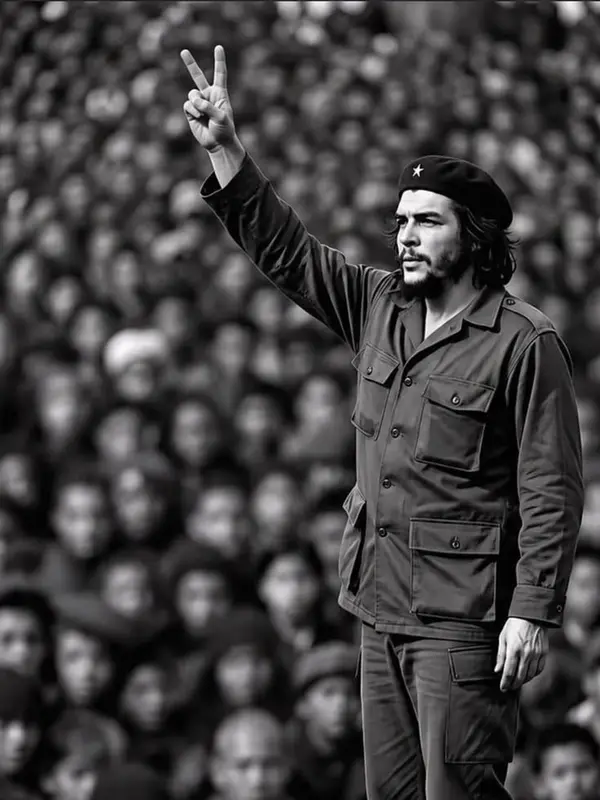
Che’s execution in Bolivia did not end his political influence. His photograph by Alberto Korda, commonly known as Guerrillero Heroico, became one of the most recognizable political images of the twentieth century. His face appeared on posters, books, murals, flags, and T-shirts, transforming a historical revolutionary into a global cultural symbol. His afterlife demonstrates how societies construct collective memory. Historical figures are remembered not only through their actual decisions but also through the hopes, grievances, and aspirations that later generations associate with them.
For many people in Latin America, Africa, and other regions shaped by colonialism and economic dependency, Che became a symbol of resistance to external domination. For radical movements, his image conveyed a willingness to challenge powerful institutions rather than accept the existing distribution of wealth and authority. Yet the commercialization of his image produced an irony. A man who criticized consumerism and the pursuit of private accumulation became a highly marketable commodity within global consumer culture. His image could be sold without any serious engagement with his economic philosophy, his revolutionary activities, or the controversies surrounding his political legacy.
This contradiction illustrates the difference between remembering a historical figure and understanding one. An image can preserve emotional identification while obscuring the complexities of the person it represents. The German-Jewish philosopher and cultural critic Walter Benjamin reflected on how the memory of defeated struggles can inspire later generations. Che’s continuing presence in political culture illustrates this possibility: the defeat of a particular movement does not necessarily erase the questions it raised. But historical memory should not become a substitute for historical inquiry. To understand Che is to study not only the symbol but also the human being, the political circumstances, the choices he made, and the consequences of those choices.
What does Che Guevara mean for a young person living in the twenty-first century? The world has changed substantially since his death. Digital communication, artificial intelligence, global supply chains, new forms of political mobilization, and changing patterns of employment have transformed the conditions under which inequality and power operate. The armed guerrilla model that shaped Che’s political life cannot simply be treated as a universal answer to contemporary problems. Yet many of the questions that animated his work remain relevant. Why do economic opportunities remain unequally distributed? Why can wealth accumulate alongside severe deprivation? How can communities exercise meaningful influence over decisions affecting their lives? Why do some countries possess formal sovereignty without adequate economic security? And what obligations do educated citizens have toward those excluded from opportunity?
Che’s life encourages young people to treat these questions as matters of public responsibility rather than distant academic abstractions. But the appropriate response today may be democratic organization, independent research, social entrepreneurship, journalism, public service, peaceful protest, or the development of institutions that make power accountable.
A student of economics can investigate how inequality is produced and evaluate policies designed to reduce it. A physician can strengthen access to health services. A journalist can expose corruption and misinformation. An engineer can develop technologies that serve neglected communities. A teacher can cultivate the intellectual independence necessary for democratic citizenship. A political activist can organize citizens while defending the right of others to disagree. Such work may appear less dramatic than guerrilla warfare, but it can produce lasting structural change. The measure of commitment is not the degree of personal sacrifice alone; it is also whether that commitment improves human lives and creates institutions capable of sustaining progress.
Che’s legacy should therefore inspire youth to combine courage with competence, solidarity with critical inquiry, and ambition with public responsibility. It should not encourage them to romanticize violence, dismiss democratic processes, or assume that personal conviction gives anyone the right to speak unquestioningly for an entire population. The most enduring tribute to Che is not to reproduce his historical choices regardless of circumstance. It is to confront the questions he placed before the world while learning from the limitations of his answers.
Ernesto “Che” Guevara remains one of the most contested political figures of the twentieth century because his life brought together ideals that continue to matter and contradictions that cannot responsibly be ignored. He was a physician who became a revolutionary, a Marxist thinker who questioned established socialist economic models, an internationalist who challenged global inequality, and a guerrilla commander whose final campaign exposed the limitations of revolutionary voluntarism. His most valuable legacy lies in the questions he raised about human dignity, economic power, international solidarity, and the relationship between individual consciousness and social transformation. His most important warning lies in the consequences of believing that a noble objective can justify methods that deny others freedom, agency, and due process.
To salute Che Guevara intellectually is not to declare him infallible. It is to take his convictions seriously enough to examine them critically. It is to recognize his courage without romanticizing violence, to acknowledge his humanism while questioning his authoritarian tendencies, and to learn from both his achievements and his failures. For the youth of today, the challenge is to create a world in which justice does not require the abandonment of freedom, where equality does not demand ideological conformity, and where solidarity strengthens rather than suppresses human dignity.
Che died at thirty-nine, but the questions his life raised remain unresolved. The responsibility of a new generation is not merely to inherit the symbols of the past. It is to develop the knowledge, institutions, and moral courage necessary to build a more equitable future one in which the pursuit of human liberation is measured not only by the ideals proclaimed, but by the freedom, dignity, and well-being of the people themselves.
Catch all the Blogs News, Breaking News Event and Trending News Updates on GTV News
Join Our Whatsapp Channel GTV Whatsapp Official Channel to get the Daily News Update & Follow us on Google News.
Must Read