
Golden Dome: A $1.2 Trillion Shield That May Not Stop a Single Russian or Chinese Missile

Golden Dome: A $1.2 Trillion Shield That May Not Stop a Single Russian or Chinese Missile
The Congressional Budget Office has done the math on Trump’s missile defense ambition. The numbers — and the physics — do not cooperate.
President Donald Trump’s proposed Golden Dome missile defense system, pitched as America’s answer to Russian and Chinese nuclear threats, has received a devastating independent assessment from the Congressional Budget Office. The nonpartisan fiscal watchdog estimates the system could cost $1.2 trillion — nearly seven times Trump’s initial $175 billion projection — while offering no guarantee of actually intercepting the threats it is designed to defeat.
The gap between the political promise and the operational reality is worth examining in detail.
What Golden Dome Would Actually Require
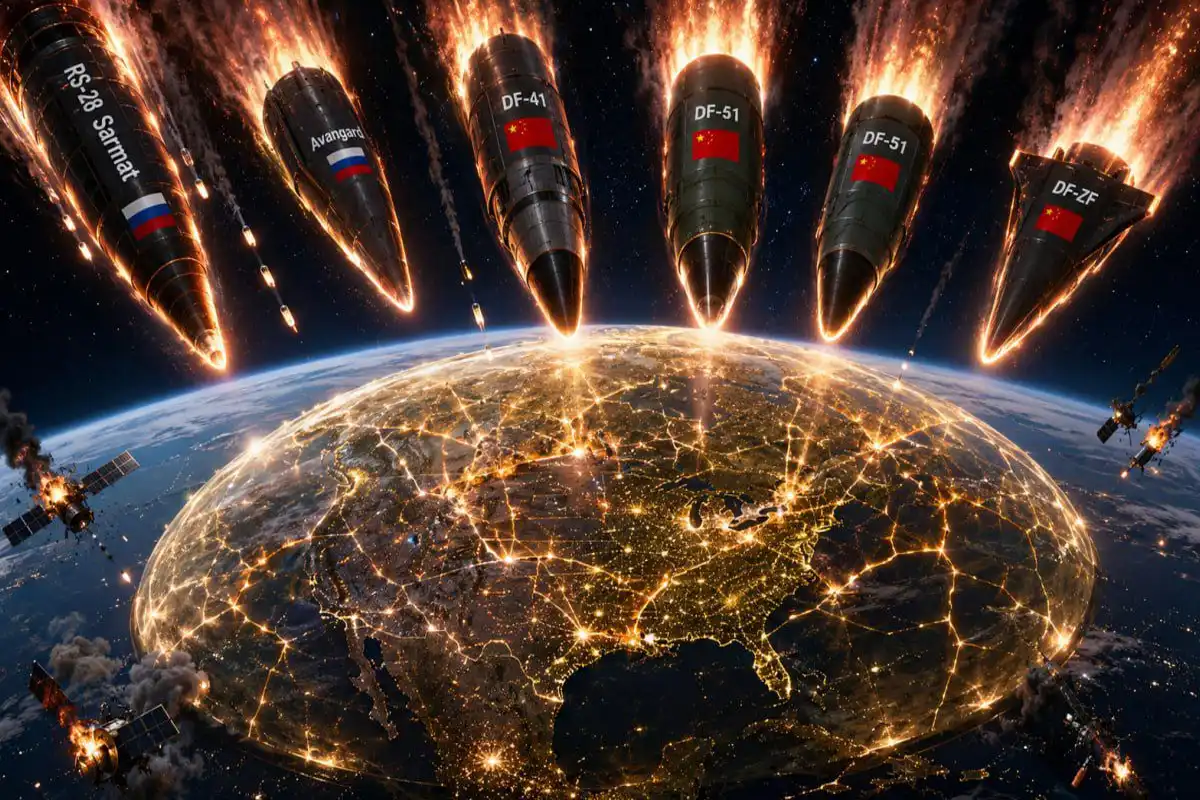
The CBO’s analysis identifies the infrastructure Golden Dome needs to function as designed: approximately 7,800 armed satellites in low Earth orbit to detect and intercept ballistic missiles in their boost phase, six major radar and missile base installations for mid-course intercept of intercontinental ballistic missiles, and 35 regional bases equipped to handle hypersonic missile threats.
Each of these components carries its own cost and vulnerability profile. The satellite constellation faces a fundamental physics problem the report identifies directly: low Earth orbit satellites experience atmospheric drag that causes orbital decay. At the altitudes required for boost-phase intercept, satellites burn up within approximately five years. The system requires continuous replacement — an ongoing expenditure that makes the $1.2 trillion figure a floor, not a ceiling.
Why Russia and China Can Defeat It Anyway
The more fundamental problem is not cost. It is strategic math.
Nuclear deterrence operates on asymmetry: offense is inherently cheaper than defense. Russia’s RS-28 Sarmat carries up to 15 independently targetable warheads per missile, along with hypersonic glide vehicles and decoys. China’s DF-41 can launch from mobile platforms in variable trajectories. Both nations can expand their warhead and delivery vehicle numbers faster and more cheaply than the United States can expand its interceptor capacity.
Senator Mark Kelly — himself a former combat pilot and astronaut — made exactly this point when criticizing Golden Dome, describing the physics as “really, really hard” and expressing confidence that the program would consume enormous resources while producing a system that does not work.
No missile defense system has ever been demonstrated to provide reliable protection against a full peer-level nuclear salvo. Golden Dome’s architecture improves on existing limited-intercept systems, but the adversaries it targets are not limited. They are unlimited, and they are already adapting.
The Opportunity Cost Nobody Discusses
The $1.2 trillion Golden Dome would consume is money not spent rebuilding the conventional munitions stockpiles Senator Kelly described as “shocking” in their depletion following the Iran war. It is money not invested in the hypersonic missile programs where the US currently lags Russia and China. It is money not available for the naval expansion that a Taiwan contingency would require.
Spending maximum resources on a defense that may not work, while underfunding the conventional capabilities that definitely would, is not a strategic choice. It is a political one.
Disclaimer; Based on Congressional Budget Office analysis and open-source defense procurement data.
Catch all the World News, Breaking News Event and Trending News Updates on GTV News
Join Our Whatsapp Channel GTV Whatsapp Official Channel to get the Daily News Update & Follow us on Google News.
Must Read