
Brazil: The Hidden Battleground Where America Is Losing to China

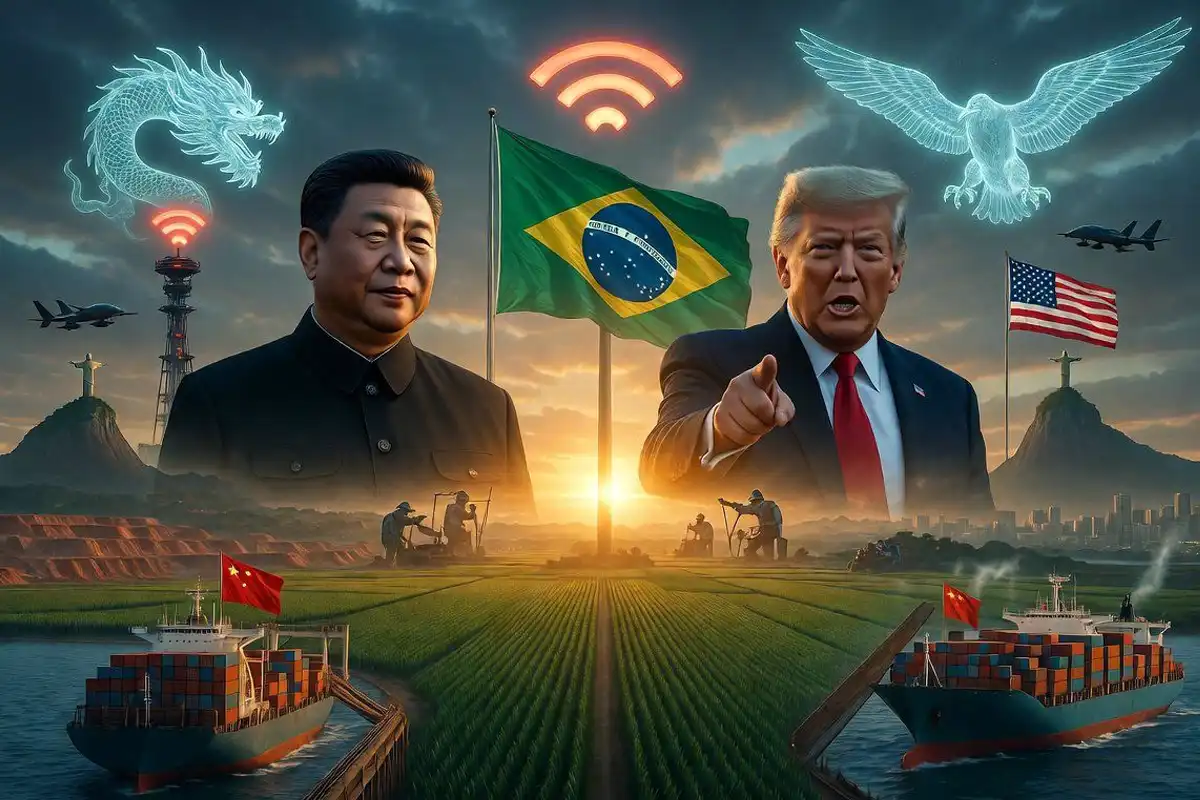
The contest for global dominance is no longer being fought on battlefields. It is being decided in port terminals, fiber-optic cables, and commodity contracts — and nowhere is this quieter war more consequential than in Brazil.
Latin America’s largest economy has become the defining test case for whether China’s infrastructure-first diplomacy can permanently displace American influence in a region Washington once treated as its exclusive backyard.
From Monroe Doctrine to Beijing’s Playbook
For nearly two centuries, the Monroe Doctrine gave Washington an unspoken veto over foreign influence in the Western Hemisphere. That era is functionally over in Brazil. China became Brazil’s largest trading partner in 2009 and has never looked back. Today, the bilateral relationship is structural, not transactional — built on soybeans, iron ore, crude oil, and lithium that Chinese industry cannot source domestically at scale.
What makes this shift historically significant is the method. Unlike Soviet-era competition, which relied on ideology and military aid, Beijing’s strategy centers on economic dependency — building ports, factories, and 5G towers that host nations increasingly cannot afford to remove or replace.
The Huawei Test Washington Failed
The clearest signal of American strategic retreat came when Brazil declined to ban Huawei from its 5G rollout. Washington applied sustained pressure, threatened allied sanctions, and promoted alternative vendors. Brasília listened politely and proceeded anyway.
Huawei now sits at the core of Brazil’s digital infrastructure. Critics argue this creates long-term data sovereignty risks and supply-chain vulnerabilities. Supporters in Brazil counter that American alternatives were slower, costlier, and came with political strings attached.
That tension reveals a broader pattern: China competes on economics while America increasingly competes on conditions.
Inside the BRICS Dollar Challenge
Brazil’s active participation in BRICS de-dollarization discussions adds a financial dimension that Washington finds alarming. Proposals to settle bilateral trade in local currencies — already partially operational between China and several partners — could gradually erode the dollar’s role as the default settlement currency for Brazilian commodity exports.
If even a fraction of Brazil’s soy and oil trade shifts away from dollar denomination, the ripple effects on US financial leverage would be measurable, not theoretical.
What America Still Holds
Washington retains meaningful assets. The Alcântara Space Launch Center in Maranhão — among the world’s most strategically located rocket facilities due to its near-equatorial position — remains accessible to American aerospace interests under existing agreements. Military-to-military ties remain active. And Brazil’s democratic institutions create friction for any relationship that looks too openly transactional with an authoritarian partner.
The Decade Ahead
Brazil’s leadership has mastered strategic ambiguity, cultivating both powers without fully committing to either. That posture is becoming harder to sustain as infrastructure dependencies deepen and geopolitical pressure intensifies.
The country that embeds itself most irreversibly — in Brazil’s ports, networks, and payment systems — will hold decisive leverage over Latin America’s future. On current trajectory, that country is not the United States.
Catch all the Blogs News, Breaking News Event and Trending News Updates on GTV News
Join Our Whatsapp Channel GTV Whatsapp Official Channel to get the Daily News Update & Follow us on Google News.
Must Read